
10 Best Hurdy-Gurdies (2026) – Buyer’s Guide for Beginners & Professionals

Disclosure: This article may contain affiliate links. If you buy through these links, we may earn a commission at no additional cost to you.
The hurdy-gurdy is one of the most distinctive instruments in European musical history. At first glance, its crank and keyboard suggest mechanical curiosity; in practice, it represents a complex synthesis of bowed string principles, drone tradition, and rhythmic articulation.
Its sound, continuous, buzzing, modal, places it at the crossroads between sacred chant, courtly dance, and vernacular song.
This guide explores the instrument’s historical development, construction, musical role, and practical considerations for choosing a hurdy-gurdy, concluding with a curated selection of instruments for beginners and advanced players.
Table of Contents
The History of the Hurdy-Gurdy
From Organistrum to Court and Street
The earliest documented ancestors of the hurdy-gurdy date back to the 10th century. The organistrum, depicted in medieval manuscripts and cathedral sculptures, was a large, two-player instrument used in sacred contexts to sustain polyphonic chant. Its mechanism, a rotating wheel acting as a continuous bow, allowed for long, stable tones suitable for liturgical music.

Over time, the instrument was reduced in size and adapted for solo performance, becoming known as the symphonia and later evolving into regional forms of the hurdy-gurdy. By the Renaissance and especially the 17th and 18th centuries, it had entered aristocratic salons in France, where the vielle à roue became fashionable among the nobility. Composers wrote refined repertoire for it, and luthiers developed increasingly sophisticated designs.
Simultaneously, the instrument remained present in popular and itinerant traditions which we will explore in the next paragraph.
The hurdy-gurdy thus moved fluidly between sacred, courtly, and popular spheres, a rare trajectory for a single instrument.
Regional Variations and Historical Revivals
Across Europe the hurdy-gurdy developed into markedly distinct regional traditions, each reflecting local musical aesthetics, dance structures, and social contexts.
In Occitan and central French traditions, particularly in regions such as Auvergne and Berry, the vielle à roue became closely associated with dance repertoires including bourrées and other modal folk forms. French instruments often emphasize a refined balance between melodic clarity and rhythmic buzzing articulation. The chien (buzzing bridge) is used with precision to accentuate dance pulse rather than dominate texture. This tradition, which survived rural decline and experienced revival in the 20th century, remains one of the most influential in contemporary hurdy-gurdy construction and pedagogy.
In Spain, the zanfoña developed primarily in Galicia and Castile, where it became intertwined with regional song and pilgrimage traditions, especially those linked to Santiago de Compostela. Spanish repertoire often integrates vocal accompaniment and narrative balladry, with a stronger emphasis on melodic continuity over aggressive rhythmic buzzing.
In Ukraine, the instrument known as the lira took on a markedly spiritual dimension. Played by itinerant blind musicians known as lirnyky, it accompanied religious chants, epic narratives, and moral songs. Ukrainian instruments historically favored stable drones and restrained rhythmic articulation, prioritizing textual clarity and devotional atmosphere.
In Hungary, the tekerőlant retained a powerful rhythmic identity. Hungarian playing technique often exploits the buzzing bridge more assertively, creating percussive accents integral to dance-driven folk traditions.
Modern Folk Revival
The modern revival, beginning in the late 19th century and intensifying in the folk revival movements of the 20th century, recontextualized the hurdy-gurdy within heritage preservation and experimental music. Today it appears in traditional ensembles, early music reconstructions, and contemporary genres including folk-rock and metal. Amplification and structural innovation have expanded its projection capacity, yet the fundamental wheel-and-drone mechanism remains intact.
Understanding these regional and historical distinctions allows listeners to perceive the hurdy-gurdy not as a single folkloric sound, but as a family of related practices shaped by context, repertoire, and cultural function.
How Does Hurdy-Gurdy Work?
Unlike bowed string instruments such as the violin, the hurdy-gurdy produces sound through a rosined wooden wheel turned by a crank. As the wheel rotates, it continuously rubs against the strings, creating a sustained tone.
The instrument typically includes melodic strings, drone strings, and one or more buzzing strings known as the trompette (or chien in French tradition). The drones provide a constant harmonic foundation, comparable to bagpipes, while the buzzing bridge produces a rhythmic vibration when the crank is accelerated with controlled wrist motion. This percussive effect transforms the instrument into both melodic and rhythmic engine.
Keys along the side of the instrument press tangents against the melodic string, shortening its vibrating length and producing different pitches. Although sometimes described as a “keyboard instrument,” its operation is fundamentally different from that of a piano or organ; the player must coordinate crank speed, pressure, and articulation simultaneously.
The result is a sound world rooted in modality and drone aesthetics, where harmony unfolds horizontally rather than through rapid chordal change.
Choosing the Best Hurdy-Gurdy: Beginner’s Guide
Acquiring a hurdy-gurdy requires particular care. Unlike mass-produced guitars or keyboards, most instruments are handcrafted by specialized luthiers. Precision in wheel alignment, tangent positioning, and string response is crucial. Even minor structural inconsistencies can significantly affect tuning stability and tonal clarity.
Other factors to consider include:
- Materials: High-quality Hurdy-Gurdies are built with sturdy wood, often maple or mahogany, for better durability and sound quality.
- Number of Strings: The number and configuration of melodic, drone, and buzzing strings influence repertoire possibilities. The standard configuration is 2 melodic strings, 2 drones and 2 trumpets (2/2/2)
- Craftsmanship and mechanical reliability matter more than numerical strings specification. A well-built instrument should produce clean sustained tone, stable drones, and a controllable rhythmic buzz.
Because of its complexity, beginners are often advised to seek guidance from experienced players or luthiers before purchasing. The hurdy-gurdy is not merely an object to acquire, but a mechanism to maintain and understand.
Student vs Professional Hurdy-Gurdy
Hurdy-gurdies vary widely in price and complexity depending on their intended level.
Student Instruments
Beginner models are usually designed to make the instrument more accessible while maintaining essential functionality.
They often feature:
- simpler decoration
- fewer strings
- durable materials
- simplified construction
These instruments allow new players to learn the basics without the cost of a high-end custom instrument.
Professional Instruments
Professional hurdy-gurdies are typically handcrafted by experienced luthiers and may include:
- additional melody or drone strings
- refined buzzing bridge systems
- advanced acoustic design
- custom decorative elements
These instruments are designed for musicians who require greater tonal control and projection in performance settings.
The following selection reflects these criteria and aims to support both beginners and advanced players in making an informed choice.
The 10 Best Hurdy-Gurdy
Best Hurdy-Gurdy for Beginners
1) Scala Vilagio Hurdy-Gurdy

Instrument Profile
| Model | Scala Vilagio |
| Soundboard | Spruce |
| Back and Sides | Maple |
| Range | Approx. 1.5 octaves |
| Tuning System | Chromatic |
| Melody String | 1 melody string |
| Drone String | 1 drone string |
| Melody String Tuning | G or F |
| Rhythmic Element | Buzzing bridge (trompette effect) |
| Origin | Made in Europe |
Acoustic Characteristics
The Scala Vilagio Ghironda Gotica is a compact hurdy-gurdy inspired by medieval and early European models, designed to produce the characteristic sustained sound of the instrument through a rotating wheel that continuously bows the strings.
Its spruce soundboard contributes to a clear and responsive resonance, while the maple body provides structural stability and balanced tonal projection. With a range of approximately one and a half octaves, the instrument is well suited for simple modal melodies typical of medieval and folk repertoire.
The presence of a single melody string combined with a drone string creates the traditional sonic texture associated with early hurdy-gurdies: a sustained tonal foundation over which melodic lines are articulated using the keyboard. The buzzing bridge mechanism (trompette) adds a rhythmic percussive element when the wheel speed is varied, a distinctive feature used historically in many European hurdy-gurdy traditions.
Strengths ✅
- Compact hurdy-gurdy design inspired by historical medieval instruments
- Spruce soundboard and maple body provide clear resonance and stability
- Chromatic keyboard allows greater melodic flexibility than purely diatonic models
- Traditional drone and buzzing bridge recreate the characteristic hurdy-gurdy sound texture
- Suitable for medieval music, folk repertoire, and historical performance contexts
Considerations ⚠️
- Limited range (about 1.5 octaves) compared to larger modern hurdy-gurdies
- Single melody string reduces polyphonic possibilities found in more complex instruments
- Requires regular wheel rosining and cotton adjustment for optimal sound
- More specialized instrument that may require familiarity with hurdy-gurdy technique for best results
2) Ancestore Hurdy-Gurdy, Trigo

Instrument Profile
| Maker | Ancestore |
| Model | Trigo |
| Body Material | Solid Sapele mahogany |
| Wheel | Black MDF wheel |
| Keyboard | 24-key chromatic keyboard |
| Range | 2 octaves |
| Melody String | 1 melody string (G4, user-changeable to C4) |
| Trompette String | 1 rhythmic string (G3) |
| Drone String | 1 drone string (G2) |
| Dimensions | Length: 55 cm (+9 cm crank), Width: 29 cm, Height: 17 cm |
| Optional Electronics | Passive piezo pickup with 6.3 mm jack output |
| Optional Accessories | Set of 3 capos (melody, trompette, drone) |
| Included Accessories | Gig bag, strap, liquid rosin, tracing paper strips for pressure adjustment, tangent tuning tool |
| Origin | Handmade in Europe |
Acoustic Characteristics
The Ancestore TRIGO Hurdy-Gurdy is a compact chromatic instrument designed to combine traditional hurdy-gurdy construction principles with modern playability. With a two-octave chromatic keyboard (24 keys) and a simplified string setup, it provides clear melodic articulation while maintaining the characteristic drone-based texture of the instrument.
The configuration of one melody string, one drone, and one trompette string creates the classic sonic architecture of the hurdy-gurdy: a sustained harmonic foundation enriched by rhythmic buzzing produced by the trompette bridge. This buzzing effect can be controlled through subtle variations in crank movement, allowing players to add rhythmic accents typical of many European hurdy-gurdy traditions.
The solid Sapele mahogany body contributes to a warm and balanced resonance, while the MDF wheel provides consistent friction and stable sound production when properly rosined. The relatively compact body size also makes the instrument more portable than many traditional hurdy-gurdies while still offering a full, resonant tone suitable for folk, medieval, and contemporary repertoire.
Strengths ✅
- Two-octave chromatic keyboard offering broader melodic flexibility than many beginner hurdy-gurdies
- Classic string configuration with melody, drone, and trompette strings
- Adjustable tangents, scale length, and saddle height allow detailed setup customization
- Solid tonewood construction with Sapele mahogany body and hardwood components
- Optional piezo pickup system for amplification during live performances
- Delivered with useful accessories including gig bag, rosin, strap, and adjustment tools
Considerations ⚠️
- Fixed bridge requires adjustments through shims rather than direct bridge regulation
- Simplified string configuration provides less tonal complexity than multi-drone professional models
- Like all hurdy-gurdies, it requires regular maintenance of wheel rosining and cotton adjustment
- Handmade instrument with custom production time that may require extended waiting periods
3) Knys Instruments Hurdy-Gurdy, Catnip B

Instrument Profile
| Maker | KNYS Instruments |
| Model | Catnip B |
| Materials | Resonance box and keybox in plywood; other parts in mahogany, sycamore, and spruce |
| Keyboard | 24-key chromatic keyboard |
| Range | 2 octaves |
| Melody Strings | 2 melody strings: C4, G3 |
| Trompette Strings | 2 rhythmic strings: G3, C4 |
| Drone Strings | 2 drone strings: G2, C3 |
| Scale Lenght | 400 mm |
| Tuners | Mechanical guitar-style tuning machines |
| Tangents | Adjustable stainless steel / brass tangents (PH1 screwdriver) |
| Bridge | Adjustable bridge (tool-free adjustment) |
| Drone Bridges | Adjustable (3 mm Allen key) |
| Scale Length Adjustment | Adjustable (3 mm Allen key) |
| Belt Mount | 3-point strap mount |
| Included Accessories | Gig bag, strap, 3 mm Allen key |
| Origin | Handmade in Poland |
Acoustic Characteristics
The Catnip B Hurdy-Gurdy is designed as an accessible instrument for players entering the world of the hurdy-gurdy while maintaining many of the acoustic features found in more advanced models. With two melody strings, two drones, and two trompette strings, the instrument produces a rich and layered sound texture typical of Central and Western European hurdy-gurdy traditions.
The 400 mm scale length and two-octave chromatic keyboard allow for flexible melodic playing across a wide range of repertoire, from medieval and folk music to contemporary experimental styles. The presence of dual trompette strings with a chien buzzing bridge enables the rhythmic percussive effect that characterizes traditional hurdy-gurdy performance.
The resonance box and tangent chest are made from precision laser-cut plywood, a practical design choice that improves structural stability and resistance to humidity while ensuring consistent key alignment. Other acoustic components such as mahogany, sycamore, and spruce, contribute to a warm and balanced tone.
The instrument is produced by KNYS Instruments, a small hurdy-gurdy workshop based in Gorlice, southeastern Poland, founded by maker Radosław Malisz. The workshop focuses on building carefully crafted instruments that combine traditional design principles with modern production methods, aiming to deliver reliable and affordable hurdy-gurdies for contemporary players.
Strengths ✅
- Designed specifically as a beginner-friendly hurdy-gurdy with professional features
- Two melody strings, drones, and trompettes provide a full traditional sound palette
- Two-octave chromatic keyboard expands melodic possibilities
- Precision laser-cut construction ensures consistent key alignment and stability
- Multiple adjustable components allow fine control over setup and intonation
- Built by a specialized workshop focused on quality handmade hurdy-gurdies
Considerations ⚠️
- Use of plywood for the body may produce a slightly different tonal character compared to fully solid wood instruments
- Like all hurdy-gurdies, it requires regular maintenance of cottoning and wheel rosining
- The complexity of setup adjustments may require initial learning for new players
- Availability may depend on production schedules or waiting lists from the maker
4) Nerdy Gurdy, Linotte

Instrument Profile
| Maker | Nerdy Gurdy |
| Model | Linotte |
| Keyboard | Chromatic keyboard |
| Range | 2 octaves |
| Melody Strings | 2 melody strings (standard: G3, G4) |
| Trompette Strings | 2 trumpet strings (standard: C4, G4) |
| Drone Strings | 2 drones (standard: G2, C2) |
| Body Design | Fully rounded body inspired by traditional hurdy-gurdies |
| Sound Holes | Traditional-style sound holes |
| String Pressure Adjustment | Individually adjustable for each string (hex key) |
| Scale Length Adjustment | Adjustable nut positions for scale length regulation |
| Construction | Improved design derived from Nerdy Gurdy BASIC and original NG v6 |
| Availability | New stock released monthly |
| Origin | Designed and produced in Europe |
Acoustic Characteristics
The Nerdy Gurdy Linotte represents an evolution of the original Nerdy Gurdy design, combining the improved mechanics of the NG BASIC platform with a body shape closer to traditional hurdy-gurdies. Its configuration of two melody strings, two drones, and two trompette strings provides a full and balanced sonic palette typical of modern chromatic hurdy-gurdy setups.
The presence of dual trompette strings allows players to produce the rhythmic buzzing effect associated with the instrument’s traditional performance practice, while the dual melody strings enhance projection and tonal richness. The redesigned rounded body and traditional sound holes contribute to improved acoustic resonance, resulting in greater volume and clearer sound quality compared with earlier versions of the instrument.
One of the defining features of the Linotte model is its highly adjustable setup system. Each string’s pressure on the wheel can be precisely controlled using a hex key, allowing players to fine-tune response and balance. Additionally, the adjustable nut positions at the head of the instrument make it possible to modify the scale length, helping players optimize intonation when using different types of strings.
The Nerdy Gurdy project was created to make hurdy-gurdies more accessible to modern players, combining traditional acoustic principles with innovative design and manufacturing techniques.
Strengths ✅
- Six-string configuration with melody, drone, and trompette strings provides a rich traditional sound texture
- Improved body design offers greater acoustic volume and tonal clarity
- Highly adjustable setup including string pressure and scale length
- Ergonomic design makes the instrument easier to adjust and maintain than earlier versions
- Traditional aesthetic with rounded body and classic sound holes
Considerations ⚠️
- Availability is limited to periodic production releases, which may require waiting for new stock
- Like all hurdy-gurdies, the instrument requires regular wheel rosining and cotton maintenance
- The adjustable setup system may require some experience to optimize sound and response
- As a modern design, it may differ slightly from the construction philosophy of historical handcrafted models
Best Professional Hurdy-Gurdy
5) Ancestore Hurdy-Gurdy, Aplo

Instrument Profile
| Maker | Ancestore |
| Model | Aplo |
| Body Material | Plywood (body, keybox, and keys) |
| Tangents | Adjustable metal tangents |
| Keyboard | Chromatic keyboard |
| Scale Length | Adjustable |
| Bridges | Adjustable melody and drone bridges |
| Melody Strings | 2 melody strings: G3, D4 |
| Trompette Strings | 1 trompette string: G3 |
| Drone Strings | 2 drones: D3, G2 |
| Crank Length | 80 mm (68 mm optional) |
| Finish | Black gloss varnish |
| Dimensions | Length: 70 cm · Width: 35 cm · Height: 22 cm |
| Optional Electronics | Passive piezo pickup with 6.3 mm jack output |
| Optional Accessories | Set of 3 capos (melody, trompette, drone) |
| Included Accessories | Liquid rosin, Y-strap, tracing paper strips for pressure regulation, tangent tuning tool |
| Optional Case | Soft case available |
| Origin | Handmade in Europe |
Acoustic Characteristics
The APLO Black Hurdy-Gurdy is a modern chromatic instrument designed to offer a balanced combination of accessibility, adjustability, and traditional hurdy-gurdy sound architecture. With two melody strings, two drones, and a trompette string, the instrument produces the layered sonic structure typical of European hurdy-gurdy traditions: sustained melodic lines supported by continuous drones and rhythmic buzzing accents.
The trompette string interacts with the buzzing bridge mechanism, enabling the characteristic rhythmic effect controlled through variations in crank motion. This feature allows players to integrate percussive articulation into melodic performance, a defining element of many folk and contemporary hurdy-gurdy styles.
The body, keybox, and keys are constructed from precision-cut plywood, offering structural stability and resistance to humidity changes while keeping the instrument more affordable than fully solid-wood models. Decorative components such as the American walnut crank handle, wheel cover, and keybox lid add visual refinement and ergonomic comfort. The adjustable bridges, tangents, and scale length provide significant flexibility for setup and tuning, allowing players to optimize the instrument for different strings or playing styles.
Strengths ✅
- Traditional string configuration with melody, drone, and trompette strings
- Adjustable tangents, bridges, and scale length allow precise setup customization
- Durable construction with stable plywood body resistant to humidity changes
- Optional piezo pickup system enables easy amplification for live performance
- Supplied with practical accessories including rosin, strap, and adjustment tools
Considerations ⚠️
- Plywood construction may produce a different tonal character compared to fully solid-wood hurdy-gurdies
- Like all hurdy-gurdies, the instrument requires regular maintenance of wheel rosining and cotton adjustment
- Custom production involves extended waiting times depending on the maker’s schedule
- Optional accessories such as case, electronics, or capos increase the overall cost
6) Early Music Shop
Early Music Shop is one of the most established retailers dedicated to historical musical instruments, offering a wide selection of instruments used in medieval, Renaissance, and early music traditions. Among its catalogue, the site features several hurdy-gurdies (ghironde) available in different configurations and price ranges.
A notable advantage of Early Music Shop is that many of the instruments are immediately available, making it a practical option for musicians who wish to purchase a hurdy-gurdy without the long waiting times often associated with custom-built instruments. The selection includes models suitable for beginners, intermediate players, and experienced musicians.
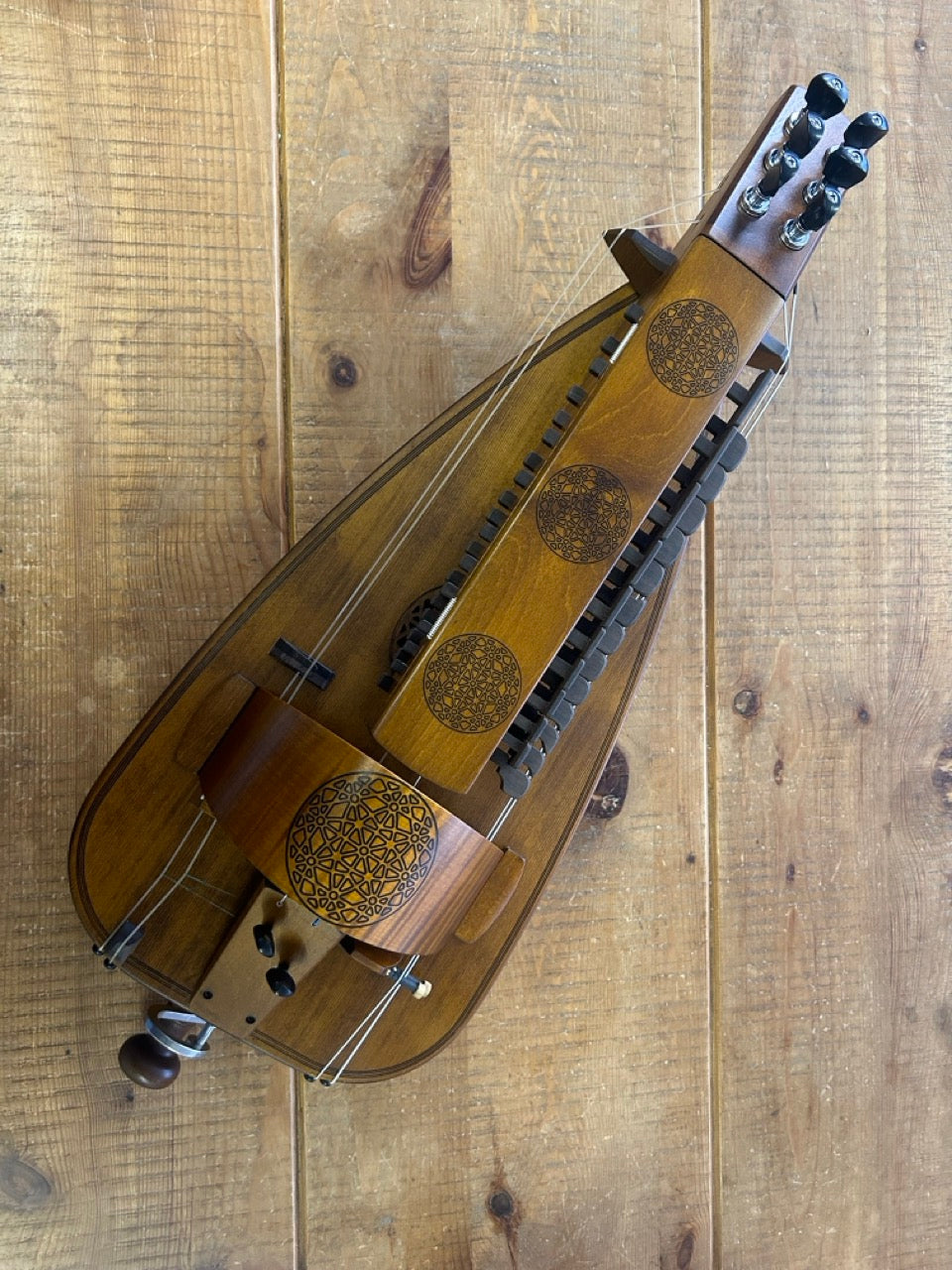
The shop also offers instruments built by respected makers such as John Verney, Helmut Gotschy, and Mihaly Vrabel, giving players access to handcrafted hurdy-gurdies from different European lutherie traditions. In addition to instruments, the site provides accessories, learning materials, and maintenance tools, supporting musicians exploring the hurdy-gurdy in both historical and contemporary contexts.
7) Liuteria Medievale – Giordano Ceccotti
The workshop of Giordano Ceccotti is dedicated to the research, reconstruction, and evolution of historical European instruments, with a particular focus on the hurdy-gurdy in both its medieval and modern forms. Based in Italy, Ceccotti combines the perspective of a performing musician with that of a historical instrument maker, creating instruments that bridge musicology, craftsmanship, and contemporary performance practice.

Among the instruments produced in his workshop, the hurdy-gurdy occupies a central role. Ceccotti builds both historically informed medieval symphonias and hardy-gurdies inspired by Renaissance and Baroque iconography, as well as modern hurdy-gurdy models designed for contemporary performance. His instruments often combine traditional tonewoods such as spruce, maple, ebony, and boxwood with refined construction details that improve stability, ergonomics, and acoustic projection.
In recent years he has also explored modern and electro-acoustic interpretations of historical instruments, including electric hurdy-gurdies and solid-body versions inspired by traditional designs. These instruments integrate features such as piezo pickups, internal preamplification, and modern tuning systems, allowing the hurdy-gurdy to function in amplified and contemporary musical settings.
Through the Liuteria Medievale workshop, Giordano Ceccotti continues to develop instruments that respect historical traditions while responding to the needs of modern musicians, making the hurdy-gurdy once again a living instrument across genres and performance contexts.
8) Sedo Garcia Luthier
The workshop of José Alfredo García Pujol, known as Sedo, is dedicated to the handcrafted construction of traditional string instruments, with a particular focus on the hurdy-gurdy. Founded in Barcelona in 1976 and later relocated near Girona, the workshop follows a fully handcrafted construction process in which every instrument is built individually with careful attention to materials, acoustics, and historical design.

Sedo Garcia’s hurdy-gurdies combine traditional European craftsmanship with modern playability. Using carefully seasoned tonewoods such as spruce, maple, walnut, and rosewood, the workshop produces a range of models, from historically inspired designs to advanced instruments used in folk and contemporary music.
Each hurdy-gurdy produced in the workshop is built personally by Sedo Garcia, with the support of his family in various stages of the process. Through decades of craftsmanship and research, the Sedo Garcia workshop has become an important reference point for musicians seeking instruments that combine historical inspiration, refined acoustics, and meticulous artisan construction.
9) Chris Allen & Sabina Kormylo Luthiers
The workshop of Chris Allen and Sabina Kormylo specializes in the construction of historically inspired string instruments, with a particular focus on hurdy-gurdies and lutes. Their work also includes mandolins, viols, and other traditional instruments, alongside repair, adjustment, and modification of existing instruments.

A defining aspect of their approach is the careful study of historical instrument models. Many of their hurdy-gurdies are based on surviving examples from European collections, and the makers place great emphasis on faithfully reproducing both the external appearance and the internal construction details of these historical instruments.
Each instrument is built individually and can be customized according to the musician’s needs. While the body design often follows historical prototypes to ensure strong acoustic performance, players may choose from a variety of options including additional strings, capos, carved headstocks, and decorative elements.
Through this combination of historical research, craftsmanship, and personalized design, the workshop offers instruments that balance authenticity with the practical requirements of modern performers.
10) Claire Dugué Hurdy-Gurdy Workshop
Claire Dugué has been building hurdy-gurdies since 1997, establishing her workshop in Ramsgate, South-East England, in 2001. Over the years she has developed a range of instruments including lute-back, guitar-shaped, and trapezoidal hurdy-gurdies, combining traditional construction with ongoing experimentation in design and acoustics.
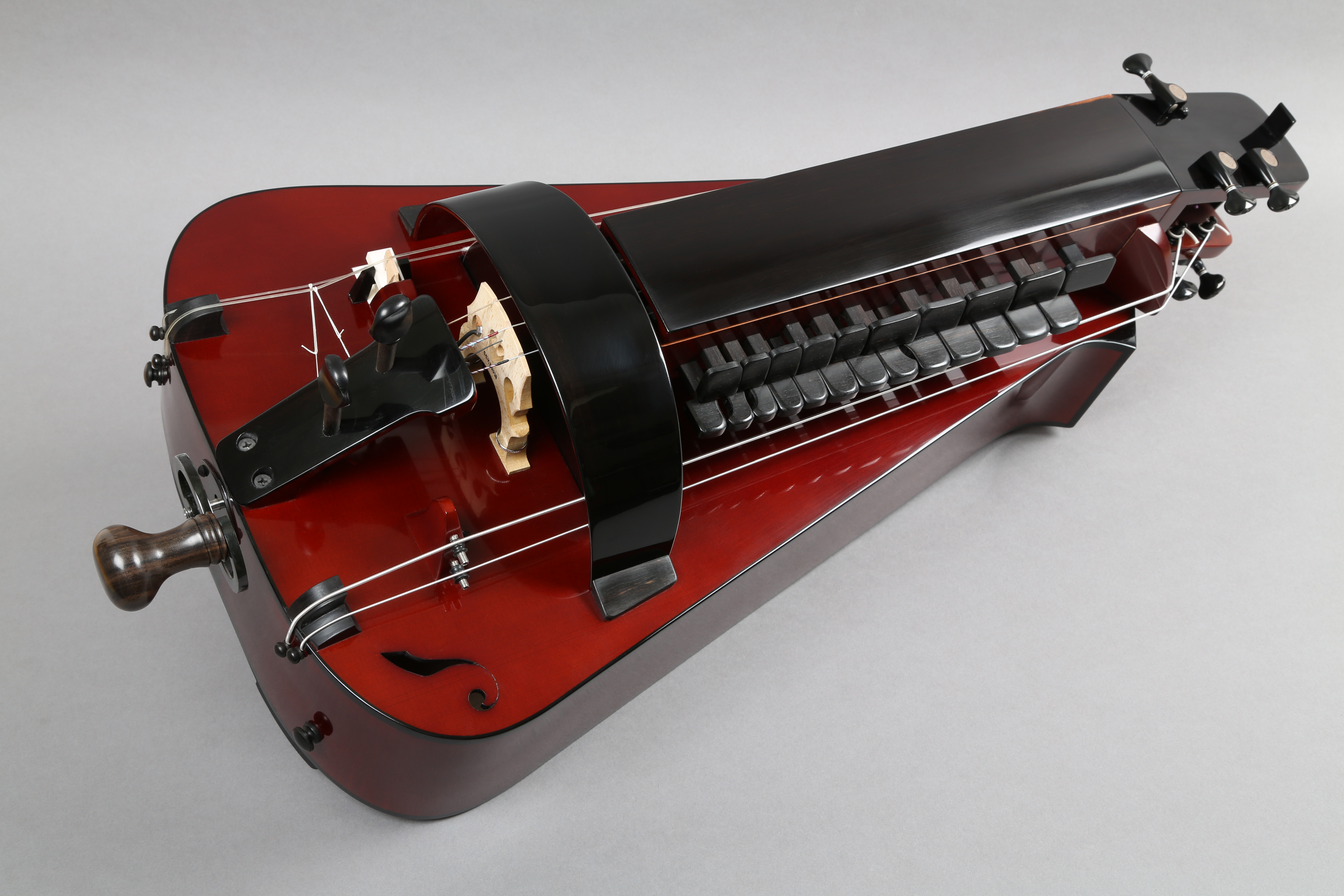
In 2014 she redesigned both the internal structure and external form of her instruments, resulting in four main models: the soprano Premier Pas and Do-Libre, the alto Exo-Skeleton, and the tenor Carapace. These instruments feature an external frame design that slightly separates the body of the instrument from the player, allowing the back to resonate more freely. This construction produces a warmer, more projecting sound and a wider dynamic range, while maintaining the characteristic clarity of the hurdy-gurdy.
Each instrument is individually handcrafted and fully customizable, reflecting Dugué’s commitment to precision, acoustics, and the evolving possibilities of the instrument. Musicians are welcome to visit the workshop to try the instruments and discuss personalized specifications.
Final Considerations
The hurdy-gurdy stands as a reminder that medieval technology was capable of remarkable acoustic ingenuity. Its rotating wheel, drone system, and rhythmic bridge embody a musical logic distinct from modern harmonic thinking, one rooted in continuity, modality, and pulse.
To approach the instrument responsibly is to recognize its layered history: liturgical origin, aristocratic refinement, popular persistence, and contemporary reinvention. Its sound may seem archaic, yet it continues to resonate within modern experimental and folk traditions.
Choosing a hurdy-gurdy, therefore, is not simply selecting an unusual instrument. It is entering a centuries-old dialogue between mechanism and music, drone and melody, continuity and transformation.
“This article is written from an educational perspective for a global audience. It does not replace the knowledge transmitted within distinct traditions, and readers are encouraged to seek information directly from original sources whenever possible.”
FAQs
Tag:Strings
