
6 Best Berimbaus for Capoeira (2026) – Buyer’s Guide & Top Picks
Disclosure: This article may contain affiliate links. If you buy through these links, we may earn a commission at no additional cost to you.
The Berimbau cannot be separated from the history of Afro-Brazilian communities. It is not simply a musical bow, nor merely the instrument of Capoeira. It is part of a cultural system shaped by forced displacement, enslavement, resistance, and ongoing Black cultural production in Brazil.
This article is written from an educational perspective for readers who may be encountering the instrument outside its cultural context. It does not replace the knowledge transmitted within Afro-Brazilian communities, nor the lived experience of mestres and practitioners. Its aim is to offer historical orientation, structural understanding, and guidance for respectful engagement.
Table of Contents

The History of the Berimbau
African Lineage and the Atlantic Passage
The Berimbau belongs to the family of African musical bows, instruments found across regions of Angola and Central Africa. Through the transatlantic slave trade, both people and cultural knowledge were violently displaced to Brazil. Within this context, musical memory survived not as folklore, but as continuity under oppression.
The instrument’s structure, a flexible wooden stave, a tensioned string, and a resonating gourd, reflects this African lineage. The name itself is likely derived from Kimbundu (Angolan) mbirimbau.
Capoeira, Criminalization, and Authority
Capoeira, the Afro-Brazilian martial art, dance, and game developed by enslaved Africans and their descendants in Brazil, is the cultural space within which the Berimbau acquired its central role.
Capoeira did not always revolve around the Berimbau in the way it does today. In its earlier documented forms, percussion instruments, especially drums, were often dominant in accompanying the game. The Berimbau gradually assumed a central role over time, particularly in the late 19th and early 20th centuries, as Capoeira evolved within urban Afro-Brazilian communities.
By the 20th century, the Berimbau had become the structural axis of the roda. It was no longer simply one instrument among others: it defined tempo, authority, and the hierarchy of the game. This shift was not merely musical, it reflected transformations within Capoeira itself.
During the period in which Capoeira was criminalized in Brazil (formally outlawed in the Penal Code of 1890), practitioners faced arrest, surveillance, and violence. Within this context, the Berimbau existed inside a climate of real danger.
Historical testimonies, including recollections attributed to mestres such as Pastinha and Noronha, suggest that some capoeiristas modified their instruments for defensive purposes, sharpening parts of the bow or adapting them in moments of confrontation. Whether frequent or exceptional, these accounts reveal something essential: Capoeira and its instruments developed within conditions of repression, not folklore neutrality.
It is important not to romanticize this dimension. The Berimbau was not “a weapon disguised as music.” Rather, it was an instrument carried by people whose cultural practices were criminalized. In such circumstances, survival and art were not separate spheres.
Understanding the Berimbau today requires acknowledging this historical reality without turning it into spectacle. Its authority within the roda is inseparable from the social history of the communities that sustained it.
Beyond Capoeira: Spiritual Context
The Berimbau also appears in Afro-Brazilian cultural-religious contexts, though it does not occupy the same central ritual position as the atabaque drums in Candomblé. References to spiritual meaning should be made cautiously and specifically, avoiding generalizations.
What remains consistent is that the instrument exists within Afro-Brazilian cultural ecosystems shaped by African cosmologies and diasporic continuity.
The toques: Rhythm as Authority and Communication
The toques, the rhythmic patterns played on the Berimbau, are far more than sequences of notes. Each toque functions as a coded language, a structured rhythmic vocabulary through which the mestre communicates with the capoeiristas inside the roda.
By altering tempo, accent, phrasing, and emphasis, the Berimbau does not merely accompany the game, it determines its pace, its emotional register, and its degree of intensity. Rhythm becomes instruction.
Traditionally, each toque corresponds to a specific style of play and atmosphere.
Angola is slow and grounded, emphasizing strategy, subtlety, deception, and connection to the earth.
São Bento Grande is faster and more confrontational, encouraging dynamic exchanges and expansive movement.
São Bento Pequeno mediates between these two energies, blending playfulness with restraint.
There are also more specialized and regional variations. Iúna, for example, is traditionally reserved for advanced practitioners and performed when only experienced players enter the roda. Its execution marks a moment of respect and refinement within the tradition.
Beyond shaping gameplay, toques historically served as signals. During the periods when Capoeira was persecuted and criminalized in Brazil, certain rhythms carried meanings understood within the community. The most widely cited example is Cavalaria, whose galloping pattern warned players of approaching police. Upon hearing it, capoeiristas would immediately stop or transform the game into something less visibly confrontational.
These functions should not be romanticized, but they demonstrate how rhythm operated as social intelligence within marginalized communities.
Even today, the choice of toque establishes the social tone of the roda. A mestre may shift rhythms mid-game to test awareness, alter intensity, encourage discipline, or mark transitions between challenge and celebration.
In this sense, the Berimbau is a regulating presence within Capoeira, a rhythmic authority that guides, instructs, and structures collective movement.
How Does the Berimbau Work?
At its core, the Berimbau is a mono-stringed musical bow: a curved wooden rod (verga), a steel or metal wire stretched between the ends (arame), and a gourd (cabaça) attached to act as a resonator.
The player uses a thin wooden stick (baqueta) to strike the string, while simultaneously manipulating a coin or stone (dobrão or pedra) to change the pitch and timbre, and often holds a small rattle (caxixi) in the same hand.

Here is how the sound is produced and controlled:
- Strike the wire with the baqueta – the vibration produces the fundamental tone.
- Varying the tension of the wire, the size and position of the gourd, and pressing the dobrão on the string allow for timbral and pitch variation. For example, pressing the cord with the coin yields a higher note, letting go yields a lower note, and allowing the gourd to touch the belly or move away changes resonance.
- The caxixi adds a rhythmic shimmering effect, but it’s the Berimbau that leads the ensemble in Capoeira, setting tempo, style and mood of the game.
Differences to Similar Instruments
Although the Berimbau has become the most internationally recognized member of the musical bow family, it is part of a much older and geographically widespread African organological tradition. Across sub-Saharan Africa, musical bows appear in multiple forms, some mouth-resonated, others equipped with calabash gourds, demonstrating how structurally simple instruments can sustain highly sophisticated musical systems.
In Southern Africa, in particular, several instruments share striking structural affinities with the Berimbau.
The uMakhweyane, associated with Zulu-speaking communities, is perhaps its closest relative. Like the Berimbau, it employs a gourd resonator and a string divided into two vibrating segments by a small loop, producing contrasting tonal areas. The string is struck with a thin stick, generating a bright metallic sound rich in overtones. Unlike the vertically played Berimbau, the uMakhweyane is typically held horizontally and played with short, articulated strokes. Historically associated with women performers, it has since become part of broader musical life in regions of Swaziland and South Africa.
The uHadi, a Xhosa unbraced bow, produces sound through a combination of striking and controlled resonance shaped by proximity to the body and mouth. The calabash is held near the chest, and subtle shifts alter timbre and projection. In contrast to the percussive, rhythm-leading role of the Berimbau in Capoeira, the uHadi often accompanies song and storytelling, creating a softer, intimate sonic environment
The Ugubhu, also rooted in Zulu tradition and documented during the era of King Shaka, predates the uMakhweyane. It traditionally uses a gut or cow-tail hair string and is struck with a light beater, producing a deep, resonant tone. Princess Magogo kaDinuzulu played a crucial role in preserving and documenting this instrument through recorded performances in the 20th century, ensuring its continuity within South African musical heritage.
Smaller bows such as the Umqangala and uMrhubhe rely primarily on mouth resonance rather than external gourds. Constructed from reed or flexible wood, they are plucked or lightly struck while the performer shapes harmonics with subtle lip and tongue adjustments. The resulting sound carries a distinctly vocal quality, reinforcing the intimate relationship between instrument and body.
The Xitende, performed among Tsonga communities, presents a larger and more dramatic variation. Sometimes reaching up to six feet in length, it is a braced bow equipped with a gourd resonator and a divided string. Often tuned to a minor third, it is played with a bouncing motion that produces rapid rhythmic patterns. Traditionally associated with itinerant musicians, the Xitende has been used to accompany sung commentary and social narrative.
Across these instruments, from the Ugubhu and uHadi to the uMakhweyane and Xitende, the underlying principle remains consistent: a flexible bow, a vibrating string, and a resonating body capable of producing layered tonalities through overtone manipulation.
The Berimbau carries this lineage into Brazil. What distinguishes it is not its structure, but its social function. In Brazil, the bow became the regulating axis of a martial-art form rather than an accompaniment to song. Its rhythms structure movement, hierarchy, and collective interaction within the roda.
Recognizing these African relatives is not an attempt to dilute the specificity of the Berimbau. On the contrary, it situates the instrument within a broader African continuum, reminding us that Afro-Brazilian cultural forms did not emerge in isolation, but from knowledge systems that long predate the Atlantic rupture.
Choosing the Best Berimbau: A Beginner’s Guide
Before purchasing a Berimbau, it is important to consider not only sound and technical aspects, but also the cultural context of the instrument. The goal is not possession of an object, but participation in a practice with history.
Other factors to consider include:
1. Materials and construction
- The “verga” (wooden bow) should be made of a flexible yet resilient wood (traditionally biriba or similar) so that it can bend slightly under tension but not crack.
- The “arame” (wire) should be strong, properly tensioned, and free of rust or breaks: many come from piano wire or recycled tire wire.
- The “cabaça” (gourd) should be well-hollowed, cleanly attached, without cracks, and sized appropriately (larger gourd → deeper tone; smaller gourd → higher tone).
2. Size and pitch
- As with many string instruments, size affects pitch: longer or larger-gourd Berimbaus tend toward lower tones (used in Capoeira as “gunga”). Shorter ones yield higher tones (viola). Choose according to your preference and physical ergonomics (e.g., height, how you hold it).
- If you are a complete beginner, it may make sense to acquire a medium-sized instrument, so you’re neither fighting with a huge bow nor limited by a very small one.
3. Accessories
- It’s essential that the instrument comes with a baqueta (stick) and a coin or pedra (stone) for pressing the string. Some kits also include a caxixi (rattle). Having a full set helps you begin playing properly.
- Consider whether you want a ready-to-play kit (pre-tensioned, tuned) or a raw set you’ll have to set up yourself.
4. Ergonomics and comfort
- Since you’ll hold the Berimbau against your body (chest or belly) and manipulate the gourd and string, make sure the weight, length and balance suit your size.
- Also check that the gourd’s attachment and the string’s tension are adjusted so that you can comfortably switch tones and experiment.
5. Sound quality
- Even as a beginner, listen if possible: strike the string, move the gourd to body, press the coin — do you hear clear distinctions between open note, closed note and buzz? A well-made Berimbau should allow those three basic sounds cleanly.
- Check for unwanted rattles, loose parts, dull sounds: good resonance, clear attack, and the ability to vary timbre are signs of good build.
6. Budget & authenticity
- Traditional hand-made instruments may cost more, but will provide better tone and durability. Cheaper decorative models (sold as souvenirs) may look like a Berimbau but often have poor sound, weak parts, or are not properly tensioned.
- If you intend serious playing (especially for Capoeira or performance), invest in quality. If you just want a decorative instrument or beginner toy, a lower budget model may suffice, but know the trade-offs.
7. Maintenance
- Check that spare wire (arame) can be replaced if needed. The gourd may crack or detach, so good construction helps.
- Learn how to re-tension the wire, adjust the gourd position, and maintain the coin/stone accessory, these affect sound and playability.
The curated selection below aims to support informed decision-making while encouraging awareness of the instrument’s cultural origins.
Top 6 Best Berimbau
Best Berimbau for Beginners
1) Meinl BE1R Berimbau
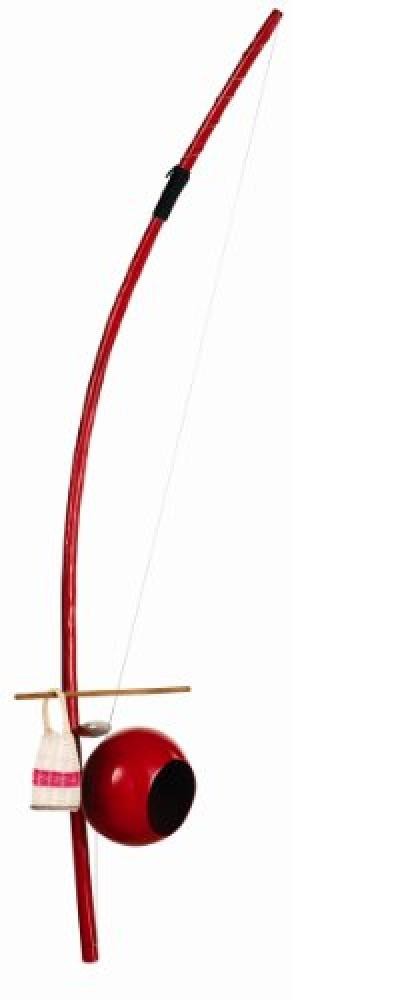
Instrument Profile
| Material | Premium fiberglass bow |
| Color | Red |
| Included Accessories | Wooden stick (baqueta), caxixi, metal coin/stone (dobrão), carrying bag |
| Construction | Modern, durable design |
| Intended Use | Capoeira practice, educational contexts, beginner to intermediate players |
Acoustic Characteristics
The Meinl BE1R represents a modern adaptation, replacing the wooden bow with fiberglass for increased durability and resistance to environmental changes.
Instruments with synthetic materials such as fiberglass tend to offer greater structural stability and consistent tension, though their tonal response may differ slightly from traditional wooden models, often resulting in a more uniform but less organically varied resonance. Suited for beginners and intermediate players.
Strengths ✅
- Durable fiberglass construction resistant to humidity and wear
- Complete kit including essential accessories for playing
- Suitable for beginners and educational use
- Stable structure requiring less maintenance than traditional wooden berimbaus
- Portable with included carrying bag
Considerations ⚠️
- Synthetic materials may produce a different tonal character compared to traditional wooden berimbaus
- Some users report inconsistencies in packaging or missing accessories
- Less connection to traditional craftsmanship compared to handmade instruments
- May not meet the expectations of advanced players seeking authentic acoustic nuance
2) Afroton DO‑BER02 Berimbau

Instrument Profile
| Lenght | Approx. 160 cm |
| Bow Material | Natural wood |
| Included Accessories | Metal disc (dobrão), stick (baqueta), caxixi |
| Construction | Traditional-style design |
| Intended Use | Capoeira practice, beginner to intermediate players |
Acoustic Characteristics
The Afroton DO-BER02 follows a more traditional construction approach, using a wooden bow that aligns more closely with the historical design of the berimbau as used in Capoeira. Instruments made from natural wood tend to produce a more organic and variable resonance, influenced by factors such as wood density, curvature, and string tension.
Compared to synthetic alternatives, wooden berimbaus often offer a more traditional tonal response, with subtle variations in timbre that many players associate with the acoustic identity of the instrument. However, this also means that sound consistency can vary slightly between instruments.
Strengths ✅
- Traditional wooden construction closer to historical berimbau design
- Full set of essential accessories included
- Suitable for players seeking a more authentic material experience
- Adequate length (approx. 160 cm) for standard playing technique
- Good entry point for Capoeira practitioners
Considerations ⚠️
- Some users report fragility in materials, especially with frequent or intensive use
- Natural wood may be more sensitive to humidity and environmental changes
- Variability in construction can lead to differences in tension and tonal response
- May require more careful handling compared to fiberglass models
Best Professional Berimbau
3) Berimbau Viola Vintage

Instrument Profile
| Instrument Type | Berimbau Viola (higher-pitched variant) |
| Bow (Verga) | Traditional shape |
| Wood | 4-layer construction (Tauarí and Curupixá) with black layers between |
| String | Stainless steel (0.9 mm) |
| Tuning System | Chromed tuning peg (tarraxa) |
| Resonator | Natural gourd (cabaça), untreated exterior, internally treated |
| Accessories | Bamboo stick (baqueta, 39 cm), stone (pedra) |
| Identification | Numbered identification plate |
| Construction | Multi-layered wooden build with reinforced structure |
Acoustic Characteristics
The berimbau viola is traditionally the highest-pitched instrument within the berimbau family (gunga, médio, viola), often associated with improvisation, variation, and rhythmic dialogue within the Capoeira roda. Its role is less about maintaining the fundamental pulse and more about expanding the rhythmic language through ornamentation and interaction.
This model’s multi-layered construction using Tauarí and Curupixá woods contributes to a balanced combination of strength and resonance, supporting stable tension while allowing for a responsive vibrational behavior of the bow. The use of a stainless steel string (0.9 mm) provides clarity and brightness, enhancing the characteristic cutting tone associated with the viola.
The natural, unvarnished cabaça plays a crucial role in shaping the sound, offering a raw, earthy resonance that can vary depending on positioning against the body. This interaction allows the player to articulate the three fundamental tonal states of the berimbau—open, closed, and buzzing—with nuance and control.
Overall, the instrument tends toward a bright, agile, and articulate sound profile, well suited for the expressive and improvisational role expected of the viola within Capoeira music.
Strengths ✅
- Designed specifically as a viola, supporting improvisation and rhythmic variation
- Multi-layered wood construction offering structural strength and tonal balance
- Stainless steel string provides clarity and projection
- Traditional natural gourd enhances authentic resonance
- Chromed tuning peg allows for more precise tuning adjustments
- Includes essential accessories for immediate use
Considerations ⚠️
- Higher-pitched response may be less suitable for players seeking deep, foundational tones
- Natural gourd requires careful handling and maintenance
- Multi-layered construction, while robust, may still be sensitive to environmental conditions
4) Berimbau Gunga Vintage

Instrument Profile
| Instrument Type | Berimbau Gunga (low-pitched variant) |
| Bow (Verga) | Traditional shape |
| Wood | 4-layer construction (Tauarí and Curupixá) with black layers between |
| String | Stainless steel (1 mm) |
| Tuning System | Chromed tuning peg (tarraxa) |
| Tuning Range | Commonly tuned around E, F, F#, G |
| Resonator | Natural gourd (cabaça), untreated exterior, internally treated |
| Accessories | Bamboo stick (baqueta, 39 cm), stone (pedra), support pin (pino de apoio) |
| Identification | Numbered identification plate |
| Construction | Multi-layered wooden build with reinforced structure |
Acoustic Characteristics
The berimbau gunga is the lowest-pitched instrument within the traditional trio (gunga, médio, viola) and serves as the foundation of the Capoeira ensemble. Its role is to establish the primary rhythmic pattern (toque), guiding both the musicians and the players of the roda.
Thanks to its thicker 1 mm steel string and larger resonating setup, the gunga produces a deep, resonant, and authoritative sound, with strong low-frequency presence. The multi-layer construction in Tauarí and Curupixá supports structural tension while allowing the bow to vibrate with stability, contributing to a full-bodied and grounded tonal response.
The natural cabaça enhances the instrument’s bass resonance, creating a rich and enveloping sound that can be modulated through body positioning. As with all berimbaus, the interplay between the open, closed, and buzzing tones allows for expressive variation, but in the gunga these are articulated with weight and clarity rather than agility.
Overall, the instrument is characterized by a slow, powerful, and anchoring sonic presence, essential for maintaining cohesion within the Capoeira roda.
Strengths ✅
- Deep, resonant tone ideal for the foundational role in Capoeira
- Reinforced multi-layer wood construction for stability and durability
- Stainless steel string (1 mm) enhances low-end presence and projection
- Natural gourd provides authentic and rich resonance
- Chromed tuning peg allows for precise tuning adjustments
- Includes full set of accessories for immediate use
Considerations ⚠️
- Larger size and tension require more physical control and experience
- Less suited for melodic or highly improvisational playing compared to the viola
- Natural materials (wood and gourd) require care and maintenance
- Heavier and less portable than smaller berimbau types
5) Berimbau Estrela Premium

Instrument Profile
| Instrument Type | Berimbau (likely Gunga or Médio depending on setup) |
| Bow (Verga) | Recurved traditional bow |
| Wood | 5-layer construction (Tauarí and Curupixá) with 4 black layers between |
| String | Stainless steel (1 mm) |
| Tuning System | Embedded chromed tuning peg (tarraxa) |
| Tuning Range | Commonly tuned around E, F, F# |
| Resonator | Natural gourd (cabaça), untreated exterior, internally treated |
| Accessories | Bamboo stick (baqueta, 39 cm), stone (pedra), support pin (pino de apoio) |
| Identification | Numbered identification plate |
| Construction | Reinforced multi-layer premium build with integrated tuning system |
Acoustic Characteristics
The Berimbau Estrela Premium is designed with a strong focus on structural refinement and acoustic stability, combining traditional materials with more advanced construction techniques. The recurved bow and five-layer laminated wood structure increase both resistance and flexibility, allowing the instrument to maintain consistent tension while supporting a controlled vibrational response.
This structural stability contributes to a full, centered tone with clear projection, particularly in the lower and mid registers depending on tuning. The 1 mm stainless steel string enhances definition and presence, while the natural cabaça provides a resonant chamber capable of producing the characteristic berimbau tonal variations (open, closed, and buzzing) with clarity.
Compared to simpler constructions, the multi-layer design tends to offer a more focused and stable sound, with less variability caused by environmental factors. The embedded tuning peg further supports precise pitch control, allowing the instrument to adapt more easily within ensemble contexts.
Overall, the instrument presents a balanced acoustic profile, combining depth, projection, and control, suitable for both foundational rhythmic roles and more articulated playing styles.
Strengths ✅
- Premium 5-layer wood construction offering strength and stability
- Recurved bow design supporting efficient tension and resonance
- Integrated tuning system allows for precise and practical pitch adjustment
- Stainless steel string provides clarity and projection
- Natural gourd ensures authentic resonance and tonal flexibility
- Complete set of accessories included
Considerations ⚠️
- More complex construction may result in a higher cost compared to entry-level berimbaus
- Natural materials still require care and maintenance despite reinforced design
- Heavier and structurally robust build may feel less immediate for beginners
- Tonal character, while stable, may feel more controlled than organically variable compared to simpler wooden bows
6) Berimbau Sa Tarraxa Preta

Instrument Profile
| Instrument Type | Berimbau (Gunga or Médio depending on setup) |
| Bow (Verga) | Recurved design |
| Wood | 5-layer construction (Muiracatiara and Tauarí) |
| String | Stainless steel (1 mm) |
| Tuning System | Embedded black tuning peg (tarraxa preta) |
| Resonator | Natural gourd (cabaça), untreated exterior, internally treated |
| Accessories | Bamboo stick (baqueta, 39 cm), stone (pedra), support pin (pino de apoio) |
| Identification | Numbered identification plate |
| Construction | Reinforced laminated wooden structure |
Acoustic Characteristics
The Berimbau Sa Tarraxa Preta combines traditional acoustic principles with a reinforced multi-layer construction, designed to offer both structural reliability and tonal consistency. The use of Muiracatiara and Tauarí woodscontributes to a balanced response, where flexibility and resistance work together to sustain stable string tension and controlled vibration.
The recurved bow enhances the distribution of tension along the instrument, supporting a focused and stable tonal projection. Paired with a 1 mm stainless steel string, the instrument delivers a clear, defined sound with enough depth to support foundational rhythmic roles while maintaining articulation across tonal variations.
The natural cabaça provides the resonant chamber essential to the berimbau’s sound production, allowing the player to shape the characteristic open, closed, and buzzing tones through movement and contact with the body. The embedded tuning system further supports precise pitch adjustment, making the instrument adaptable in ensemble contexts.
Overall, the acoustic profile tends toward clarity, control, and structural stability, with a sound that remains consistent across different playing conditions.
Strengths ✅
- 5-layer wood construction enhancing durability and stability
- Combination of Muiracatiara and Tauarí for balanced resonance
- Recurved bow supports efficient tension and tonal focus
- Embedded black tuning peg allows for accurate and practical tuning
- Stainless steel string provides clear and defined projection
- Includes complete set of essential accessories
Considerations ⚠️
- Reinforced construction may result in a slightly less organic tonal variability compared to simpler bows
- Natural gourd and wood require regular care and maintenance
- Heavier and more structured build may feel less immediate for beginners
- Exact tonal role (gunga or médio) depends on setup and tuning
Final Considerations
To engage with the Berimbau responsibly requires more than learning how to strike its string or reproduce its rhythms. It asks for historical awareness. The instrument emerges from the African diaspora, shaped by the forced displacement of peoples whose musical knowledge survived the violence of the Atlantic slave trade. In Brazil, it was developed, refined, and sustained within Black communities who transformed inherited African bow traditions into something structurally central to Capoeira and Afro-Brazilian cultural life.
Its global circulation today does not erase this trajectory. Afro-Brazilian practitioners, mestres, artisans, teachers, and communities, remain the primary custodians of the knowledge systems that give the Berimbau meaning. Technique, repertoire, and authority are transmitted within living lineages, not abstract musical categories.
For this reason, the Berimbau carries historical memory. Its sound is inseparable from the communities that preserved it under conditions of repression and that continue to redefine it in the present.
To approach the Berimbau, then, is to enter an ongoing cultural conversation, one that demands respect, listening, and an understanding that the instrument’s resonance extends beyond music.
“This article is written from an educational perspective for a global audience. It does not replace the knowledge transmitted within Afro-Brazilian communities, and readers are encouraged to seek information directly from original sources whenever possible.”
