
6 Best Nyckelharpas (2026) – Buyer’s Guide & Top Picks
Disclosure: This article may contain affiliate links. If you buy through these links, we may earn a commission at no additional cost to you.
The Nyckelharpa is one of the most distinctive bowed instruments in European musical history. Deeply rooted in Swedish tradition yet increasingly present on international stages, it occupies a unique position between folk heritage and contemporary revival. Its combination of bowed strings, sympathetic resonance, and a system of wooden keys gives it both a visually striking appearance and a sonority unlike any other string instrument.
Far from being a folkloric curiosity, the Nyckelharpa represents a sophisticated evolution of medieval bowed instruments adapted to Nordic musical aesthetics. Its sound, rich in overtones and sustained resonance, carries a sense of space and atmosphere often associated with Scandinavian landscapes and dance traditions.
This guide explores the instrument’s historical development, construction, musical role, and practical considerations for choosing a Nyckelharpa, concluding with a curated selection of instruments for beginners and advanced players.
Table of Contents

History of the Nyckelharpa
The name Nyckelharpa literally means “key harp”, though the instrument is neither a harp nor plucked. The term refers instead to the keyed mechanism that alters pitch. Iconographic evidence from 14th-century Swedish church carvings confirms its medieval presence, particularly in the Uppland region. These early depictions reveal that keyed bowed instruments were already part of sacred and secular soundscapes in Scandinavia.
For centuries, the Nyckelharpa remained largely regional, accompanying traditional dances and village celebrations. Unlike the violin, which became standardized across Europe, the Nyckelharpa evolved locally, resulting in several historical variants with different string numbers and key systems.
Its survival into the modern era is largely due to 20th-century revival movements. Central to this revival was Eric Sahlström (1912–1986), a musician and instrument maker who refined the chromatic Nyckelharpa design. His work stabilized tuning systems, improved mechanical reliability, and expanded the instrument’s repertoire. Thanks to these developments, the Nyckelharpa moved from rural tradition to conservatory study, and today it is taught formally in Swedish music institutions.
An annual international festival in Sweden further reflects its transformation from regional instrument to global symbol of Nordic folk culture.
Repertoire and Contemporary Use
Historically, the Nyckelharpa was inseparable from Swedish dance traditions such as the polska. These pieces often feature modal structures, shifting accents, and melodic ornamentation that reflect older Scandinavian musical language.
In recent decades, however, the instrument has transcended its traditional boundaries. It now appears in early music ensembles, experimental projects, and cross-genre collaborations. Its timbre blends surprisingly well with both medieval repertoire and contemporary arrangements, and it has become a fixture in Nordic folk revivals beyond Sweden, including in Germany, France, and Italy.
This expansion has not erased its roots. Rather, it has reinforced its identity as an instrument capable of bridging historical continuity and modern reinterpretation.
For a broader listening perspective, our curated Scandinavian playlist situates the Nyckelharpa within the wider Nordic soundscape in which it continues to evolve.
Construction and Acoustic Identity
At first glance, the Nyckelharpa resembles a hybrid between a fiddle and a small hurdy-gurdy, yet its mechanics are entirely distinct. The modern chromatic Nyckelharpa typically features sixteen strings: three or four melody strings that are bowed directly, one or more drone strings, and a set of sympathetic strings running beneath them. These sympathetic strings vibrate in response to played notes, creating a shimmering resonance that enhances sustain and tonal depth.
The defining feature of the instrument is its key system. Wooden keys, mounted on a row of sliding tangents, press against the melody strings when depressed, effectively shortening the vibrating length and changing pitch. Unlike fretted instruments, this system produces a slightly percussive articulation at the beginning of each note, contributing to the instrument’s rhythmic clarity in dance music.
The instrument is usually held vertically against the chest or supported by a strap. Because the left hand operates keys rather than directly pressing strings, intonation stability differs from that of the violin family. The bowing technique, however, requires similar control and nuance, particularly in traditional polskas and other asymmetrical dance forms that demand subtle rhythmic inflection.
The result is a tone that is warm, textured, and harmonically dense. The sympathetic strings generate a natural reverberation effect, giving the impression that each note blooms outward rather than fading quickly.st or side and uses a combination of keys and bow movements to produce sound. The result is a warm tone rich in harmonics, evoking ancient and evocative atmospheres.
Choosing the Best Nyckelharpa: Beginner’s Guide
Selecting a Nyckelharpa requires attention not only to craftsmanship but to acoustic balance. The relationship between melody strings and sympathetic strings must feel coherent; excessive resonance can blur articulation, while insufficient resonance diminishes the instrument’s characteristic depth.
Other factors to consider include:
- Instrument Mechanic: Mechanical precision in the key action is essential, as uneven response can affect both playability and tonal consistency.
- Craftsmanship: High-quality Nyckelharpas are typically handcrafted from spruce and maple, woods traditionally associated with bowed string instruments.
- Accessories: Check for a good-quality bow and a protective case
Because the instrument is less standardized than the violin, consulting experienced players or makers is particularly advisable before purchasing.
While entry-level instruments exist, serious musicians often prefer handcrafted models that reflect established Swedish building traditions.
The following selection reflects these criteria and aims to support both beginners and advanced players in making an informed choice.
The 6 Best Nyckelharpa
Best Nyckelharpa for Beginners
1) Instrumentarium Nyckelharpa

Instrument Profile
| Maker | Instrumentarium |
| Lenght | Approx. 85 cm |
| Widht | Approx. 16 cm |
| Playable Strings | 3 |
| Sympathetic Strings | 8 |
| String tuning | G–D–A |
| Keys | G string: 7 keys · D string: 10 keys · A string: 15 keys |
| String Type | Pyramid Nyckelharpa strings (playable) · Pyramid .013 steel guitar strings (sympathetic) |
| Materials | Spruce (monoxylic construction), beech, oak, pear wood |
| Finish | Linseed oil and wax |
| Included Accessories | Bow, shoulder strap, gig bag, rosin, clip-on tuner |
| Available Colors | Brown, Blue, Black, Green, Natural Wood |
Acoustic Characteristics
This model by Instrumentarium follows the typical modern chromatic nyckelharpa configuration with three bowed strings tuned G–D–A and eight sympathetic strings. The keys press tangents against the strings, shortening the vibrating length and allowing the performer to change pitch while maintaining a bowed articulation similar to that of the violin family.
The combination of wooden key mechanisms, sympathetic resonance, and bowed sustain gives the nyckelharpa a tone that is often described as both warm and bright, capable of carrying melodic lines while creating a natural harmonic halo. Instruments of this type are commonly used in Swedish folk traditions, particularly in regional dance repertoires, but they have also gained popularity in contemporary folk, early music, and experimental ensembles.
Strengths ✅
- Traditional nyckelharpa construction with sympathetic strings for rich overtone resonance
- Complete starter package including bow, strap, gig bag, rosin, and tuner
- Built with solid tonewoods such as spruce, beech, oak, and pear
- Chromatic key system enabling access to a wide melodic range
- Suitable for players interested in Nordic folk music and contemporary folk ensembles
Considerations ⚠️
- The key mechanism and sympathetic strings require some adjustment for players coming from violin-family instruments
- Slightly larger and heavier than many bowed instruments, often played with a shoulder strap
- Best suited for repertoire that embraces the instrument’s distinct resonant character, particularly Nordic traditions
2) Electro-Acoustic Nyckelharpa
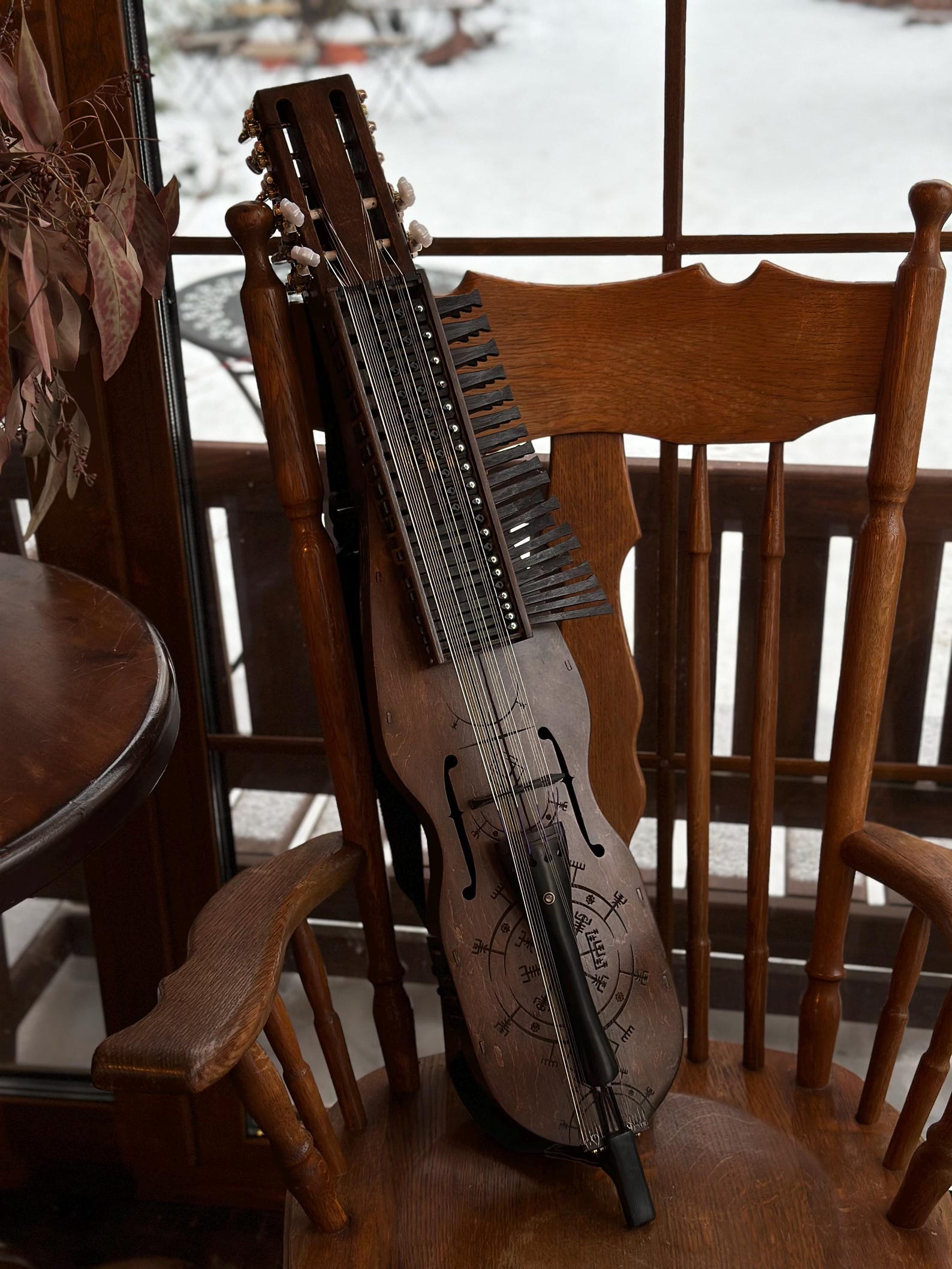
Instrument Profile
| Maker | HurdyStore |
| Construction | Handcrafted |
| Number of Strings | 16 |
| Instrument Type | Electro-acoustic |
| Pickup System | Built-in pickup for amplification |
Acoustic Characteristics
This 16-string electro-acoustic model expands the instrument’s versatility by combining traditional acoustic resonance with modern amplification. When played acoustically, the nyckelharpa produces a warm, resonant tone enriched by sympathetic vibrations, giving it a characteristic shimmering sound often associated with Swedish folk music.
The integrated pickup allows the instrument to be connected to amplifiers, audio interfaces, or stage systems, making it suitable for live performances, recording sessions, and contemporary folk or experimental ensembles. This hybrid design preserves the traditional sonic character while enabling greater projection and tonal control in amplified contexts.
Strengths ✅
- Electro-acoustic design allows both traditional acoustic playing and amplified performance
- 16-string configuration provides rich resonance and overtone depth
- Handcrafted construction, making each instrument unique
- Built-in pickup suitable for stage performance and recording setups
- Suitable for musicians exploring Scandinavian folk music, modern folk, or experimental genres
Considerations ⚠️
- Made-to-order production means waiting times (up to ~8 weeks) before delivery
- Electro-acoustic systems may require additional amplification equipment for optimal performance
- Nyckelharpa technique and key mechanisms require adaptation for players coming from violin-family instruments
Best Professional Nyckelharpa
3) Ancestore Nyckelharpa

Instrument Profile
| Maker | Ancestore |
| Key System | 3 rows of keys |
| Top Wood | Spruce |
| Back & Sides | Maple |
| Head | Okoume |
| Key Material | European pear wood (Pyrus communis) |
| Scale Length | 400 mm |
| Strings | D’Addario Helicore Viola strings |
| Machine Heads | Custom-made tuning machines |
| Weight | Approx. 2 kg |
| Finish Options | Orange, Chestnut, Dark Brown |
| Accessories (optional) | Bow and cases available separately |
| Production | Handmade, made to order |
Acoustic Characteristics
This instrument by Ancestore combines traditional construction with modern components such as D’Addario Helicore viola strings, which are known for their stability and responsive bowing characteristics. The spruce soundboardprovides clarity and projection, while the maple back and sides contribute warmth and structural stability.
Like most nyckelharpas, the instrument’s sound is shaped not only by its bowed strings but also by the complex interaction of resonance within the body and sympathetic vibrations. The result is a tone that is rich, resonant, and slightly shimmering, capable of carrying melodic lines with both clarity and depth. Such instruments are widely used in Swedish folk traditions, though they are increasingly heard in early music ensembles and contemporary folk contexts.
Strengths ✅
- Three-row key system typical of modern chromatic nyckelharpas, enabling a broad melodic range
- Built from traditional tonewoods including spruce, maple, and pear wood keys
- Uses D’Addario Helicore strings, known for reliable response and tuning stability
- Custom machine heads support precise tuning adjustments
- Handmade instrument with individually crafted details
Considerations ⚠️
- Made-to-order instrument with a long production time (approximately 24 months)
- Bow and protective case are not included in the base price and must be purchased separately
- Additional shipping costs or customs duties may apply for international orders
4) Peder Källman Nyckelharpa Workshop
Peder Källman is a Swedish violin maker, restorer, and nyckelharpa builder whose work combines classical violin-making traditions with Swedish folk instrument craftsmanship. Trained between 1982 and 1986 under Finnish master Carlo Bergman, who transmitted the Cremonese tradition learned from makers such as Giuseppe Ornati and the Sgarabotto family, Kallman has worked professionally as a luthier since 1986.
Based in Gothenburg, his workshop focuses on violin making, restoration, and the construction of high-quality nyckelharpas, drawing on both his experience as a professional instrument maker and his long-standing involvement as a nyckelharpa player and teacher. Kallman has played the instrument since the 1970s and became a riksspelman (nationally accredited folk musician) in 1979.

His instruments include a traditional chromatic nyckelharpa model inspired by the historic Sahlström instruments and the tenor nyckelharpa developed in collaboration with musician Johan Hedin, an instrument designed to expand the sonic possibilities of the nyckelharpa family. Through his workshop, teaching activity, and participation in the Swedish Guild of Violin Makers, Kallman continues to contribute to the preservation and evolution of Swedish folk instrument making traditions.
5) Leif Alpsjö Nyckelharpa Workshop
Leif Alpsjö is a Swedish musician, teacher, and instrument maker deeply involved in the revival and international dissemination of Swedish folk music and the nyckelharpa tradition. A riksspelman (nationally accredited Swedish folk musician), Alpsjö has spent decades performing, teaching, and promoting traditional music across Sweden, Europe, and the United States. In 1995 he also played a key role in founding the American Nyckelharpa Association (ANA), helping expand global interest in the instrument.
Alongside his musical activity, Alpsjö runs a workshop and shop specializing in nyckelharpas, violins, and related accessories, serving both professional musicians and students. His instruments typically feature high-quality tonewoods such as alpine spruce tops and figured maple backs, designed to produce a tone that is soft, strong, and resonant while remaining lightweight and comfortable to play.

Through instrument making, educational publications, and decades of teaching courses and workshops, Leif Alpsjö has contributed significantly to the transmission and international recognition of the nyckelharpa and Swedish folk music traditions.
6) Olle Plahn Nyckelharpa Workshop
Olle Plahn is a Swedish nyckelharpa maker who has been involved in woodcraft and instrument building since his early years. He built his first nyckelharpa in 1979, beginning a long career dedicated to refining the construction and functionality of this traditional Scandinavian instrument.
Plahn’s instruments are developed in close dialogue with prominent nyckelharpa players such as Esbjörn Hogmark and Olov Johansson, ensuring that both sound and ergonomics meet the practical needs of performing musicians. His workshop primarily produces chromatic three-row nyckelharpas, though he has also built a variety of other models including children’s instruments and specialized variants such as soprano, alto, tenor, and octave nyckelharpas.

A key focus of Plahn’s work is playability and structural reliability, with instruments designed to perform consistently even in challenging climates. Through this approach, his workshop contributes to the ongoing development and versatility of the modern nyckelharpa family.
Final Considerations
The Nyckelharpa stands as a testament to the resilience of regional instrument-making in a globalized musical world. Its medieval origins, 20th-century revival, and contemporary vitality demonstrate how tradition can adapt without losing its core identity.
To approach the Nyckelharpa is to encounter a different conception of bowed sound—one shaped not by orchestral uniformity but by local dance rhythms, resonance, and craftsmanship. Whether heard in a Swedish village gathering or on an international stage, its voice remains unmistakably Nordic yet increasingly universal.
“This article is written from an educational perspective for a global audience. It does not replace the knowledge transmitted within distinct traditions, and readers are encouraged to seek information directly from original sources whenever possible.”
Tag:Strings
