
7 Best Kalimbas (2026) – Buyer’s Guide for Beginners & Professionals
Disclosure: This article may contain affiliate links. If you buy through these links, we may earn a commission at no additional cost to you. As an Amazon Associate we earn from qualifying purchases.
The kalimba has become one of the most recognizable small instruments of the last decades. Its clear, bell-like tone and intuitive layout have made it popular among beginners and experienced musicians alike. Yet, beyond its contemporary visibility, the kalimba belongs to a much older sub-Saharan African family of lamellophones, instruments that produce sound through plucked metal tines.
To understand the kalimba properly, it is useful to acknowledge that it developed from earlier African lamellophones, particularly the mbira traditions of southern Africa. However, the modern kalimba as we know it today represents a standardized and globally distributed adaptation of those older instruments, shaped for portability, accessibility, and Western tuning systems.
This article is written from an educational perspective for readers who may be encountering the instrument outside its cultural context. It does not replace the knowledge transmitted within original communities, nor the lived experience of practitioners. Its aim is to offer historical orientation, structural understanding, and guidance for respectful engagement.
Table of Contents

The History of Kalimba, the “thumb piano”
The kalimba belongs to a broader family of African lamellophones that have existed for centuries across sub-Saharan regions. While these instruments developed in diverse local forms, the name “kalimba” became internationally recognized in the mid-20th century.
In the 1960s, the instrument was popularized internationally thanks to Hugh Tracey, a British ethnomusicologist who introduced a standardized version of the kalimba to Western audiences. By simplifying its construction and adapting it to diatonic tuning systems, Tracey made the instrument more accessible to the general public, particularly within educational and recreational contexts. This moment marked a turning point: the kalimba shifted from being part of specific African musical ecosystems to becoming a portable global instrument.
Unlike many Western instruments that rely on harmonic progression, the kalimba naturally encourages cyclical melodic patterns. Its note layout, usually arranged symmetrically from the center outward, invites alternating thumb movement, generating flowing, repetitive motifs. This structural feature explains why even simple patterns can feel immersive and meditative.
Modern kalimbas reflect this adaptation. They are typically built with precisely cut steel tines mounted on hardwood bodies and tuned to Western scales, allowing immediate melodic playability even for beginners. It is important to emphasize that the modern kalimba represents a standardized instrument developed for global circulation and designed for portability and accessibility.
The table below highlights the main differences between the kalimba and other traditional lamellophones.
| Instrument | Region | Characteristics |
| Mbira | Zimbabwe | Ceremonial instrument with complex tuning |
| Likembe | Congo Basin | Box resonator lamellophone |
| Karimba | Southern Africa | Regional lamellophone variant |
| Kalimba | Global adaptation | Standardized modern design |
How Does Kalimba Work?
The kalimba consists of a wooden board or resonating box onto which metal tines are mounted. Each tine produces a specific pitch depending on its length and tension. When plucked with the thumbs, the vibration travels through the wood, amplifying the sound.
While traditional lamellophones were often built with locally sourced wood and hand-forged metal keys, contemporary kalimbas are typically crafted from hardwood bodies with precisely cut steel tines.
Some models feature a hollow body with sound holes, allowing subtle tonal modulation by partially covering them with the fingers. Others are flat-board designs without a resonating chamber, producing a softer, more intimate sound.
Unlike keyboards or guitars, most kalimbas place the lowest notes near the center of the instrument and progressively higher notes toward the outer edges.
This layout allows alternating thumb movement between the left and right hand, making repeating melodic patterns easier to perform and creating the flowing cyclical character often associated with the instrument.
Beyond Simplicity
The kalimba is often marketed as a “relaxation instrument.” While its sound can certainly evoke calm, reducing it to a decorative or therapeutic object overlooks its place within a broader African lamellophone tradition.
Approaching the kalimba with awareness means recognizing that even a small, accessible instrument carries historical depth. Its global diffusion reflects how musical ideas travel, adapt, and evolve across contexts, without losing their core acoustic identity.
Choosing the Best Kalimba: Beginner’s Guide
When selecting a kalimba, the first and most important element remains the sound. Listen for clarity, sustain, and balance between the central and outer notes. An instrument that feels stable and evenly tuned will always be more rewarding than one chosen solely for decorative design.
Other factors to consider include:
- Number of keys: Kalimbas can have from 5 up to over 21 keys. A 17-key kalimba offers a balanced range for most players without becoming overly complex.
- Material: The type of wood influences resonance: mahogany tends to produce warm tones, while denser woods may offer brighter projection.
- Resonance: Hollow-body instruments generally provide greater volume, whereas flat-board models offer subtlety and precision.
- Tuning: Most commercially available kalimbas are tuned in C major, which allows players to produce consonant melodies easily. However, alternative tunings are available and can significantly change the expressive character of the instrument. Tuning stability is essential. Ensure that the instrument includes a proper tuning hammer and that the tines are securely mounted. Poorly manufactured models often suffer from buzzing or unstable pitch.
Types of Kalimba
| Type | Characteristics | Typical Use |
| Hollow Body Kalimba | Resonating chamber with sound holes | Louder acoustic projection |
| Flatboard Kalimba | Solid wooden board without sound box | Softer, more intimate sound |
| Chromatic Kalimba | Two rows of tines including semitones | Advanced repertoire |
| Electrified Kalimba | Built-in pickup or electronics | Stage performance and recording |
| Membrane Kalimba (Sansula) | Resonating membrane amplifies sound | Ambient and meditative music |
If you want to explore the traditional mbira traditions in greater depth, see our dedicated guide to the mbira.
The curated selection below aims to support informed decision-making while encouraging awareness of the instrument’s cultural origins.
The 7 Best Kalimba
Best Kalimba for Beginners
1) 17-key Kalimba for beginners (best price)

Instrument Profile
| Number of Keys | 17 steel tines |
| Body Material | Wood |
| Tine Material | Mineral steel |
| Dimensions | 7.08 x 5.08 x 1.18 inches |
| Key Markings | Notes engraved on the tines |
| Included Accessories | – Tuning Hammer – Flannelette Bag – 2° Finger Covers – Cleaning Cloth – Instruction Book – Thumb Piano Key Color Stickers |
Acoustic Characteristics
The 17-key Newlam kalimba produces a warm, clear and bell-like tone typical of modern thumb pianos. The mahogany body contributes to a rounded and resonant sound with balanced midrange warmth, while the mineral steel tines provide bright articulation and long sustain.
With its 17-key layout, the instrument allows players to perform melodies across a wider range compared to smaller kalimbas. The result is a pleasant, melodic sound suitable for simple songs, improvisation and meditative playing, making it especially accessible for beginners exploring the instrument for the first time.
Strengths ✅
- 17 keys provide a wider melodic range than smaller beginner kalimbas
- Engraved note markings and included stickers help beginners learn quickly
- Ergonomic body design improves comfort during extended playing
- Comprehensive accessory set
- Lightweight and portable instrument
Considerations ⚠️
- Entry-level construction compared with handcrafted professional kalimbas
- Steel tines may require occasional tuning with the included hammer
- Sound projection is relatively soft compared with larger acoustic instruments
2) Kalimba Gecko 17 Keys in Mahogany

Instrument Profile
| Brand | Gecko |
| Number of Keys | 17 steel tines |
| Body Material | Solid mahogany wood |
| Tine Material | Mineral alloy steel |
| Weight | Approx. 800 g |
| Key Markings | Notes engraved on the tines |
| Construction | Handcrafted wooden body |
| Included Accessories | – EVA protective case, – learning manual with QR video guide |
Acoustic Characteristics
The Gecko 17-Key Kalimba produces a warm, mellow tone with clear bell-like articulation, characteristic of well-crafted wooden thumb pianos. The mahogany body contributes to a balanced tonal profile with strong midrange warmth and smooth sustain, while the mineral steel tines provide bright attack and precise note clarity.
With its 17-key layout, the instrument offers a comfortable melodic range suitable for simple melodies, traditional kalimba repertoire, and beginner improvisation. The solid wooden body also enhances resonance, allowing the instrument to deliver pleasant sustain and natural acoustic amplification during solo playing.
Strengths ✅
- High-quality mahogany body produces warm and resonant tone
- 17-key layout provides a versatile melodic range for beginners and casual players
- Mineral steel tines ensure clear articulation and stable tuning
- Engraved notes help beginners learn quickly
- Includes protective EVA case and learning materials with video guide
- Suitable for home practice, relaxation, recording, and small performances
Considerations ⚠️
- Limited chromatic capability compared with larger or chromatic kalimba models
- Soft acoustic projection compared with amplified instruments
- Requires occasional tuning adjustments with a tuning hammer
Best Professional Kalimba
3) Kalimba Moozica 21 keys, electrified

Instrument Profile
| Brand | Moozica |
| Number of Keys | 21 metal tines |
| Body Material | Solid mahogany |
| Tuning Range | F3 – E6 |
| Scale | C Major |
| Pickup | Built-in piezoelectric pickup |
| Electronics | Integrated preamp with effects |
| Effects | Chorus and Delay |
| Key Markings | Engraved musical scale |
Acoustic Characteristics
The Moozica K21EQX Electrified Kalimba combines the traditional acoustic warmth of a wooden kalimba with modern amplification and onboard effects. The solid mahogany body provides a warm, resonant tone with balanced sustain, while the CNC-carved internal structure enhances vibration transfer across the soundboard.
The integrated piezo pickup and preamp system captures the natural sound of the tines and allows it to be amplified without significant loss of tonal detail. Built-in chorus and delay effects add depth and spatial character to the sound, making the instrument suitable not only for acoustic playing but also for recording, stage performance, and ambient sound design.
With 21 keys spanning F3 to E6, the instrument offers an extended melodic range compared with standard 17-key kalimbas, allowing for more complex melodic arrangements and harmonies.
Strengths ✅
- 21 keys provide a wider melodic range than standard beginner kalimbas
- Built-in piezo pickup enables amplification for stage or recording
- Integrated chorus and delay effects expand sonic possibilities
- Solid mahogany body produces warm resonance and good sustain
- CNC-carved construction improves vibration transfer and tonal clarity
- Engraved scale markings assist both beginners and experienced players
Considerations ⚠️
- Electronics add complexity compared with purely acoustic kalimbas
- Requires amplification equipment to fully utilize electronic features
- Heavier and slightly less portable than smaller traditional kalimbas
4) Kalimba Moozica 36 keys with flat top

Instrument Profile
| Brand | Moozica |
| Number of Keys | 36 metal tines |
| Body Material | Solid mahogany |
| Tuning Range | D3 – E6 |
| Layout | Double-layer piano-style layout (diatonic + semitone rows) |
| Construction | Single-piece carved wooden body (flat top design) |
| Dimensions | 15.2 × 3.3 × 19.8 cm |
| Tine Design | Slim-waist tines with drop-shaped tips |
| Accessories Included | – Kalimba case, – tuning tools, – tone stickers, – cleaning cloth, – gift packaging |
Acoustic Characteristics
The Moozica 36S Chromatic Kalimba expands the expressive possibilities of the traditional thumb piano by introducing a 36-key chromatic layout inspired by the structure of a piano keyboard. The two-layer configuration places diatonic notes on the first row and semitones on the second, enabling players to perform music in multiple keys and more complex harmonic passages.
The flat-top solid mahogany body produces a bright, focused tone with strong clarity, particularly in the higher register where many kalimbas tend to lose definition. The specially designed slim-waist tines enhance vibration efficiency, allowing the instrument to maintain clear sustain and balanced articulation across its wide pitch range. This makes the instrument suitable not only for simple melodies but also for advanced arrangements, chords, and chromatic passages.
Strengths ✅
- 36-key chromatic layout allows playing in multiple keys and complex melodies
- Piano-style double-layer arrangement improves musical versatility
- Solid mahogany body produces bright and clear tonal response
- Special slim-waist tine design improves clarity in higher registers
- Drop-shaped tine tips facilitate glissando and chord playing
- Includes accessories such as tuning tools, case, and cleaning cloth
Considerations ⚠️
- Chromatic layout may require more practice for beginners
- Larger number of tines can make the instrument slightly heavier than standard kalimbas
- Flat-top design offers a more focused tone but less natural acoustic amplification than hollow kalimbas
5) Moozica 36-Key Chromatic Kalimba, Flat Top, Electrified

Instrument Profile
| Brand | Moozica |
| Number of Keys | 36 metal tines |
| Body Material | Solid mahogany |
| Tuning Range | F3 – E6 |
| Layout | Double-layer chromatic layout (diatonic + semitone rows) |
| Construction | Flat-top solid-body design |
| Body Thickness | Approx. 3.4 cm |
| Pickup | Built-in piezoelectric pickup |
| Electronics | Integrated preamp |
| Effects | Chorus and Delay |
| Tine Design | Slim-waist tines with drop-shaped tips |
Acoustic Characteristics
The Moozica BKS36 Electrified Chromatic Kalimba combines an extended chromatic range with modern amplification and effects. Its 36-key double-layer layout places diatonic notes on the upper row and semitones on the lower row, enabling performers to play chromatic passages, modulations, and harmonically complex arrangements rarely possible on traditional kalimbas.
The solid mahogany flat-top body produces a bright, focused tone with clear articulation, especially in the higher register. The slim-waist tine design enhances vibration efficiency, allowing each note to maintain a clean bell-like attack and balanced sustain across the instrument’s full range.
The integrated piezo pickup and onboard preamp allow the kalimba to be amplified for stage or studio use, while the chorus and delay effects add depth, shimmer, and spatial character. These features make the instrument suitable not only for acoustic playing but also for ambient music, live performance, and modern experimental soundscapes.
Strengths ✅
- 36-key chromatic layout greatly expands melodic and harmonic possibilities
- Double-layer design allows intuitive playing of chromatic scales
- Built-in piezo pickup enables amplification for stage or recording
- Integrated chorus and delay effects add atmospheric sound textures
- Solid mahogany body provides warm resonance with clear articulation
- Slim-waist tine design improves clarity and sustain across the full range
Considerations ⚠️
- Chromatic layout may require adaptation for beginners
- Electronics require amplification to fully utilize sound effects
- Flat-top design produces a focused tone but slightly less acoustic volume than hollow-body kalimbas
6) HOKEMA Sansula Deluxe Kalimba
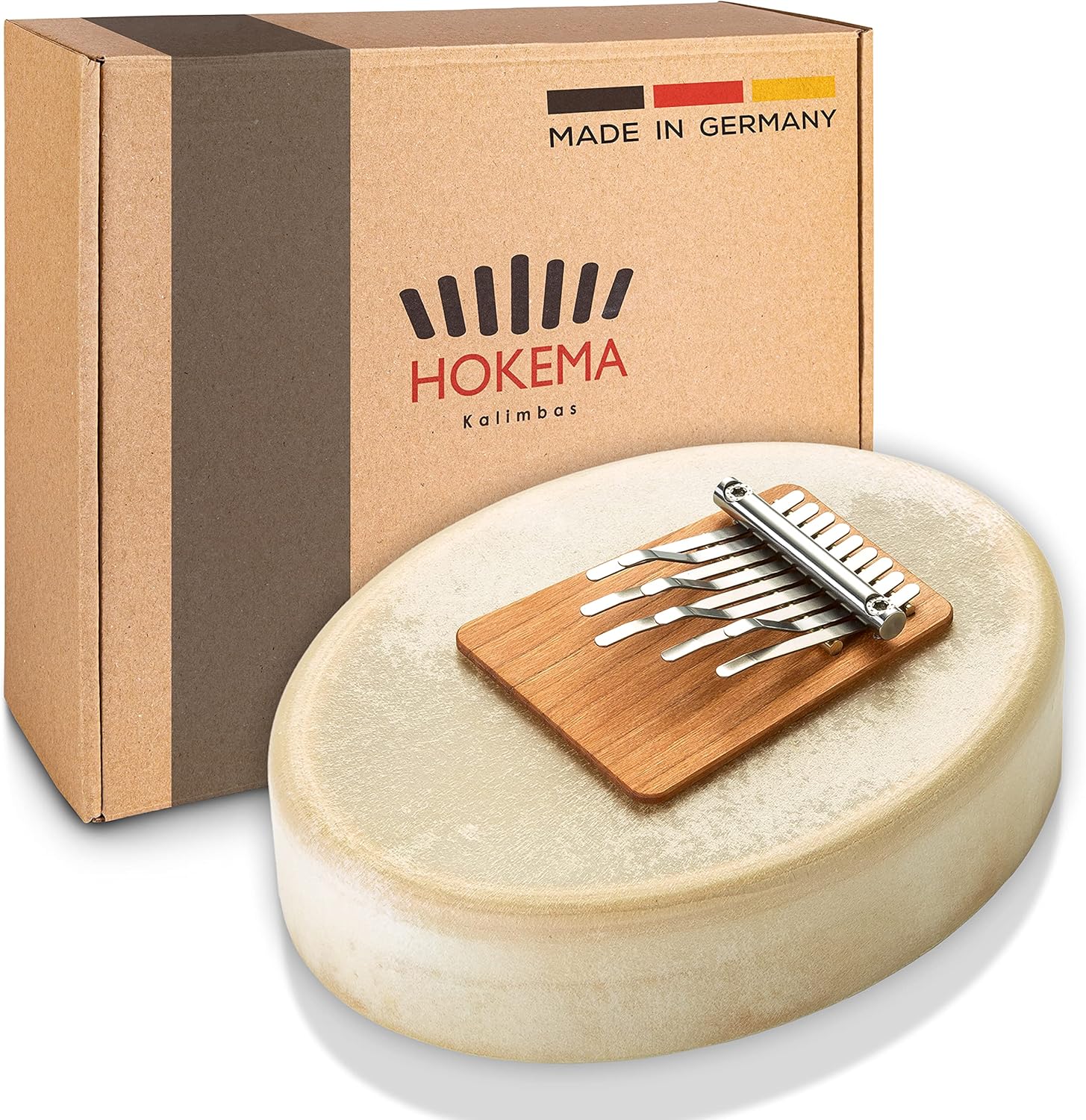
Instrument Profile
| Brand | HOKEMA |
| Model | Sansula Deluxe |
| Material | Wood body with goat skin membrane |
| Tines | Metal lamellae |
| Tuning | A minor (A – C – C – A – A – F – E – E – B) |
| Dimensions | Approx. 198 × 155 × 67 mm |
| Resonance System | Membrane amplification with tensioning mechanism |
Acoustic Characteristics
The HOKEMA Sansula Deluxe produces a soft, floating, and highly resonant sound that distinguishes it from traditional wooden kalimbas. Instead of relying solely on a solid resonance chamber, the instrument transfers the vibrations of the metal tines through a wooden block into a goat skin membrane, which acts as a secondary resonator.
This design generates a longer sustain and a more diffuse, atmospheric tone, often described as warm, shimmering, and meditative. The A minor tuning, with adjacent octave notes, allows players to create rich harmonic textures and gentle melodic patterns, making the instrument particularly well suited for ambient music, relaxation, and improvisation.
The adjustable membrane tension system introduced in the Deluxe version further enhances the instrument’s dynamic responsiveness and tonal flexibility.
Strengths ✅
- Innovative patented design combining kalimba tines with a resonant membrane
- Goat skin membrane produces longer sustain and a soft, atmospheric tone
- A minor tuning allows intuitive melodic playing and harmonious improvisation
- Adjustable membrane tension increases tonal control and versatility
- Durable construction compared with earlier Sansula models
- Compact and highly expressive instrument suitable for meditation, sound therapy, and ambient music
Considerations ⚠️
- More delicate than solid-body kalimbas and requires careful handling
- Unique resonance system produces a softer projection compared with louder acoustic instruments
- Limited note range compared with larger multi-key kalimba models
7) Hugh Tracey Kalimba
Kalimba Magic is one of the most specialized online stores dedicated entirely to kalimbas and related thumb pianos, with a particular focus on the historic instruments developed by Hugh Tracey. Founded by kalimba researcher and educator B.W. “Bill” Bicknell, the site has become an important international reference point for players interested in both traditional African lamellophones and modern kalimba designs.
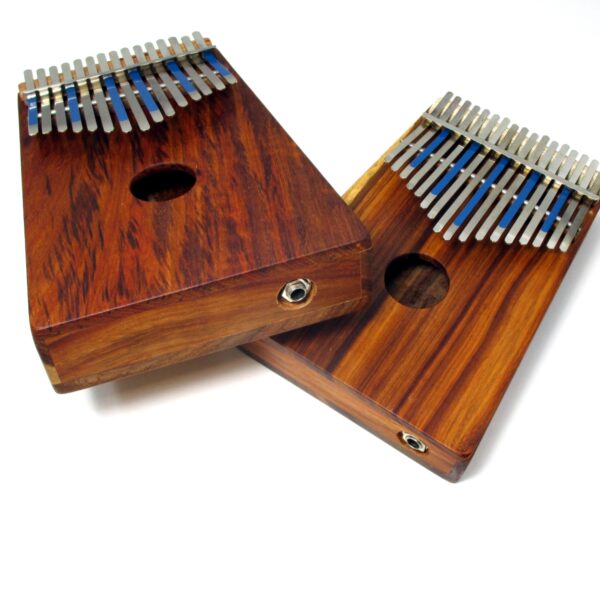
The shop offers a wide selection of Hugh Tracey kalimbas, instruments originally developed in South Africa in the mid-20th century and still considered among the most influential modern adaptations of the African mbira family. Models are available in different tunings and configurations, making them suitable for beginners, educators, and experienced performers.
Beyond instruments, Kalimba Magic provides extensive learning resources, including tuning guides, instructional material, repertoire arrangements, and educational content designed to help players explore the musical possibilities of the kalimba. For many musicians around the world, the site functions not only as a store but also as one of the most comprehensive online hubs for kalimba culture, history, and technique.
Final Considerations
The kalimba stands at the intersection of tradition and modern accessibility. It can be an entry point into plucked idiophones, a compositional tool, or simply a personal instrument for intimate exploration.
Choosing one carefully is less about brand and more about resonance, both sonic and cultural.
“This article is written from an educational perspective for a global audience. It does not replace the knowledge transmitted within original communities, and readers are encouraged to seek information directly from original sources whenever possible.”
FAQ
Tag:Percussions
