
7 Best Santurs (2026) – Buyer’s Guide for Beginners & Professionals
Disclosure: This article may contain affiliate links. If you buy through these links, we may earn a commission at no additional cost to you.
The Santur (also spelled Santoor) is a hammered string instrument belonging to the broad family of psalteries and deeply rooted in the musical traditions of Persia (present-day Iran) and neighboring regions. With its trapezoidal shape and layered, resonant sound, the Santur plays a central role in several classical musical systems across Iran, South Asia, and parts of the Middle East.
The Santur is part of living musical practices shaped by oral transmission, community learning, and long-standing teacher–student relationships. Today, it is played both within its cultures of origin and globally by musicians approaching it from diverse cultural and musical backgrounds.
This guide introduces the Santur’s history, construction, and musical role, while offering practical guidance for those interested in choosing an instrument. The final section presents a carefully curated selection of Santurs available online, intended to support informed and respectful engagement.
Table of Contents

The History of Santur and Persian Culture
The origins of the Santur can be traced back more than 3,000 years to ancient Persia. The name Santur is commonly associated with two Persian words (“san,” meaning “100,” and “tur,” which refers to the strings), though its etymology is debated and varies across traditions.
Historically, the Santur held an important place in Persian court music and later traveled across regions through cultural exchange, migration, and shared musical practices. Variants of the instrument appear in South Asia, the Middle East, and Eastern Europe, each adapted to local musical systems while maintaining a recognizable structural core.
These movements were not linear transmissions from a single center, but reciprocal processes, shaped by musicians, communities, and everyday social life. Within Iranian classical music, the Santur remains closely connected to the radif tradition and to forms of musical knowledge transmitted through listening, memorization, and guided practice rather than written notation alone.
Today, the Santur remains a cornerstone of Iranian classical music within the radif and dastgah system, while also playing an important role in Kurdish traditions and in the Kashmiri Santoor repertoire of Hindustani classical music. At the same time, it continues to evolve within contemporary Persian ensembles, film music, and cross-cultural projects without losing its cultural grounding.
From Santur to Santoor: Structural and Musical Adaptation
As the instrument reached the Indian subcontinent, particularly Kashmir, it underwent a significant transformation, both organological and musical.
The Indian santoor, as developed in the context of Hindustani classical music, differs from the Persian santur not only in size and construction, but in its underlying musical logic. Through the work of musicians such as Pandit Shiv Kumar Sharma, the instrument was adapted to meet the demands of raga performance, a system based on extended melodic development over time.
This transformation is reflected in its structure:
- Persian santur → fewer bridges (commonly 9–12), more compact layout
- Indian santoor → ~30+ bridges, expanded string system, wider range
These changes reflect a shift in musical priorities:
- In the radif/dastgah system, the santur emphasizes → precision, articulation, and modal clarity
- In the raga system, the santoor emphasizes → sustain, expansion, and long-form melodic development
The instrument, therefore, adapts to the temporal structure of the music itself: short, articulated phrases versus extended, unfolding melodic lines.
How Does Santur Work?
The santur is a trapezoidal string instrument in which sound is produced by striking metal strings stretched across a wooden resonant body.
The strings are arranged in courses (groups of strings) and pass over a series of bridges (kharak) that divide the instrument into different pitch areas. Each bridge supports multiple strings tuned to the same note, creating a full and resonant tone when struck.
Unlike fretted or fingered instruments, pitch on the santur is determined by:
- the position of the bridges
- the tuning of each string group
This creates a fixed spatial layout where each area of the instrument corresponds to specific notes within a modal system.
The instrument is played using two lightweight wooden hammers, known as mezrab, which strike the strings with controlled motion. Sound is shaped not only by where the string is struck, but also by:
- the angle and weight of the mezrab
- the timing between strokes
- the use of damping techniques to control sustain
Because each note is distributed across multiple strings, the santur produces a shimmering, layered sound, where resonance and articulation must be carefully balanced.
Tuning plays a central role in how the instrument functions. Rather than being fixed, it is adapted to the modal framework in use, requiring the player to understand both the layout of the instrument and the relationships between pitches.
Understanding this structure is essential when choosing an instrument, as design and layout directly shape both sound and playability.
Choosing the Best Santur: Beginner’s Guide
Choosing a santur means choosing not only an instrument, but a musical pathway.
The first step remains essential: listen carefully. The relationship with the instrument begins with its sound, and this cannot be replaced by specifications.
Beyond that, several structural elements directly influence both sound and usability:
- Material: The quality of the wood is essential to determine the sound of the instrument. High-end Santurs are usually made of walnut, maple or mulberry wood, which offer a better resonance. Budget instruments, on the other hand, can be made of lighter woods that produce a less deep sound.
- Strings: The number and material of the strings influence the tone and timbre. Brass strings produce a warmer sound, while steel strings can be brighter. More strings means greater complexity and playing possibilities. It is important to choose a Santur that allows for flexible tuning. The best models allow you to easily vary the tuning to adapt to different musical styles.
- Accessories: Hammers (mezrab), tuning tools, and a stable case are essential, but more importantly, the instrument should allow for reliable tuning and structural stability, especially given the sensitivity of multi-string instruments.
- Structural Layout: A 9-bridge santur offers accessibility and simplicity, while 12 or 14 bridges allow greater flexibility within the dastgah system. Larger systems, such as those found in Indian santoor, support extended melodic development.
The selection below reflects these criteria and is intended to support both beginners and more experienced players in making an informed choice.
The 7 Best Santur
Best Santur for Beginners and Intermediate
1) 9 Kharak Persian Santur for Beginners NAS-202
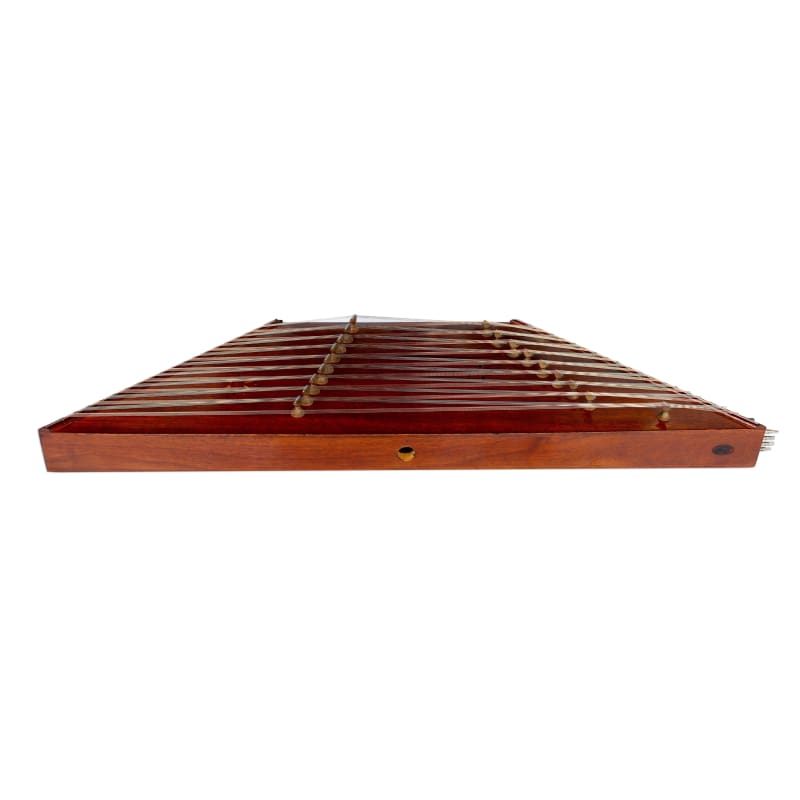
Instrument Profile
| Instrument Type | Persian Santur |
| Skill Level | Beginner |
| Wood | Walnut |
| Bridges (Kharak) | 9 bridges |
| Strings | Brass and Steel |
| Tuning | G scale (9-note configuration) |
| Dimensions | 90 × 26.5 × 7 cm |
| Weight | Approx. 2.8 – 3.1 kg |
| Hammers (Mezrab) | 2 included |
| Accessories | Hard case, extra strings, tuning wrench |
Acoustic Characteristics
This NAS-202 Santur, built with a walnut body, offers a warm and balanced resonance, helping to slightly soften the natural brightness of the metal strings. The combination of brass and steel strings produces a clear, shimmering tone, with distinct separation between registers: brass strings tend to sound warmer, while steel strings provide brilliance and projection.
With its 9-bridge configuration, this instrument reflects a simplified structural layout, often used in beginner instruments. While it offers a more limited range compared to professional santur (which typically feature more bridges and extended note systems), it provides a clear and manageable introduction to the instrument’s spatial and modal organization.
The sound is articulate and rhythmically precise, supporting both melodic development and the intricate patterns characteristic of Persian music. However, the reduced number of bridges means less modulation flexibility, making it more suitable for foundational learning rather than advanced repertoire.
Strengths ✅
- Walnut body provides warmth and balanced resonance
- Clear and defined tone from brass and steel strings
- Simplified 9-bridge layout ideal for beginners
- Complete set (case, mezrab, strings, tuning tool)
- Good introduction to Persian santur structure and technique
- Manageable size and weight
Considerations ⚠️
- Limited range compared to professional santur models
- Reduced flexibility for complex modal modulation
- Requires regular tuning (common for multi-string instruments)
- Tonal depth and sustain more limited than higher-end instruments
- Not suitable for advanced repertoire or professional performance
2) 9 Kharak Traditional G-based Scale Santur
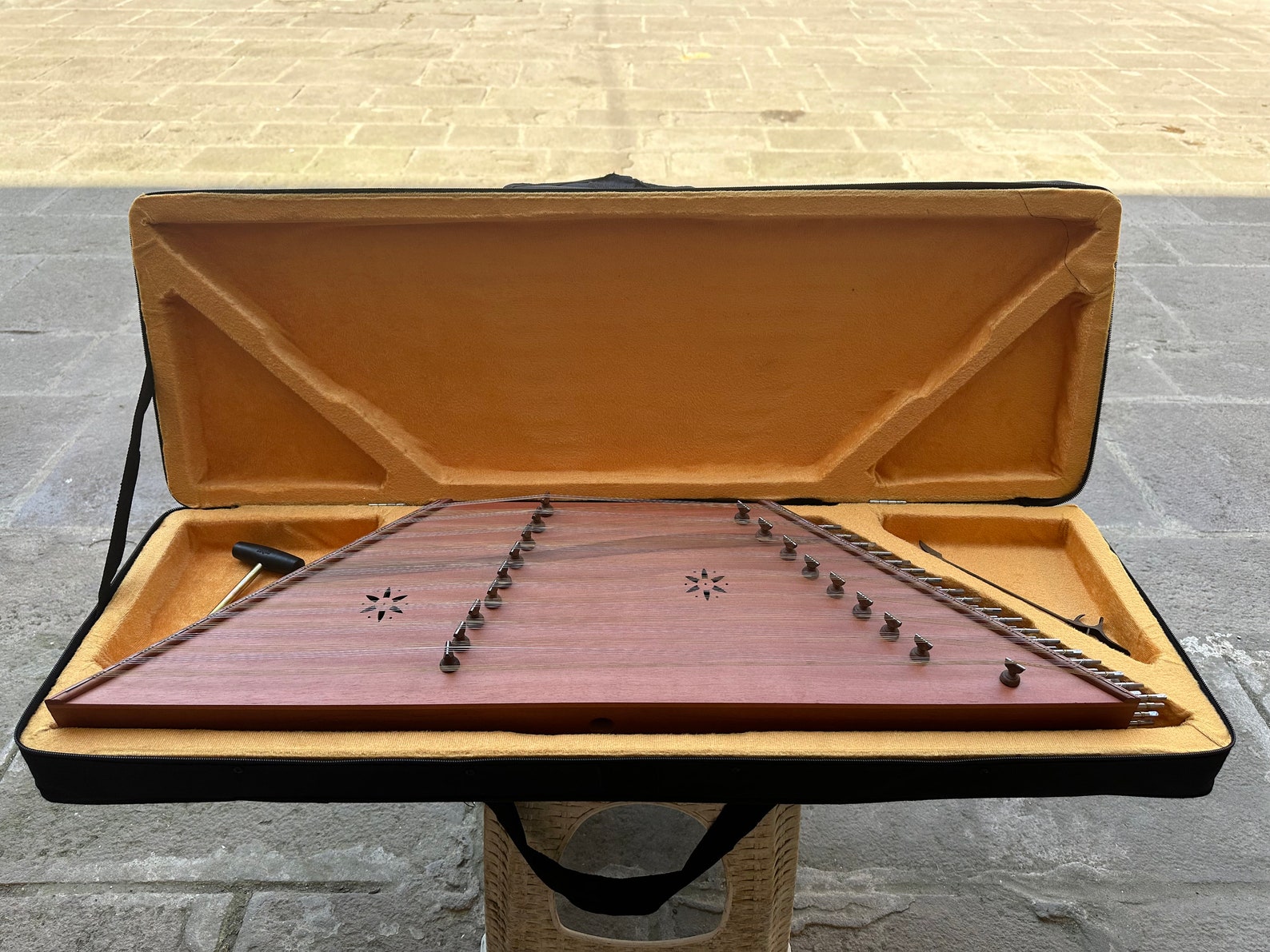
Instrument Profile
| Instrument Type | Persian Santur |
| Skill Level | Beginner to Intermediate |
| Wood | Not specified |
| Bridges (Kharak) | Not specified |
| Strings | Metal strings (not specified) |
| Tuning | G-based scale |
| Hammers (Mezrab) | 2 included |
| Accessories | Hard case, tuning key |
Acoustic Characteristics
This G-tuned santur appears to be designed as an accessible entry point, offering a clear and stable tonal frameworkrather than an extended modal range. Instruments configured around a fixed tonal center are often used for early-stage learning, where the focus is on understanding string layout, striking technique, and basic melodic development.
The sound can be expected to be direct and transparent, with a balance between brightness and sustain typical of metal-string santur. Without detailed specifications on bridge count or string configuration, it likely provides a simplified structural layout, prioritizing ease of approach over full modal flexibility.
Strengths ✅
- Handcrafted construction
- Accessible tuning suitable for beginners
- Clear and direct sound for learning basic technique
- Complete setup (mezrab, case, tuning tool)
- Suitable for introducing santur layout and playing mechanics
Considerations ⚠️
- Limited information on materials and structural details
- Likely reduced modal flexibility compared to full classical santur
- Not specifically designed for advanced repertoire
- Requires regular tuning and maintenance
- Marketing positioning (“meditation”) does not reflect the instrument’s full cultural context
3) Entry-Level Indian Santoor
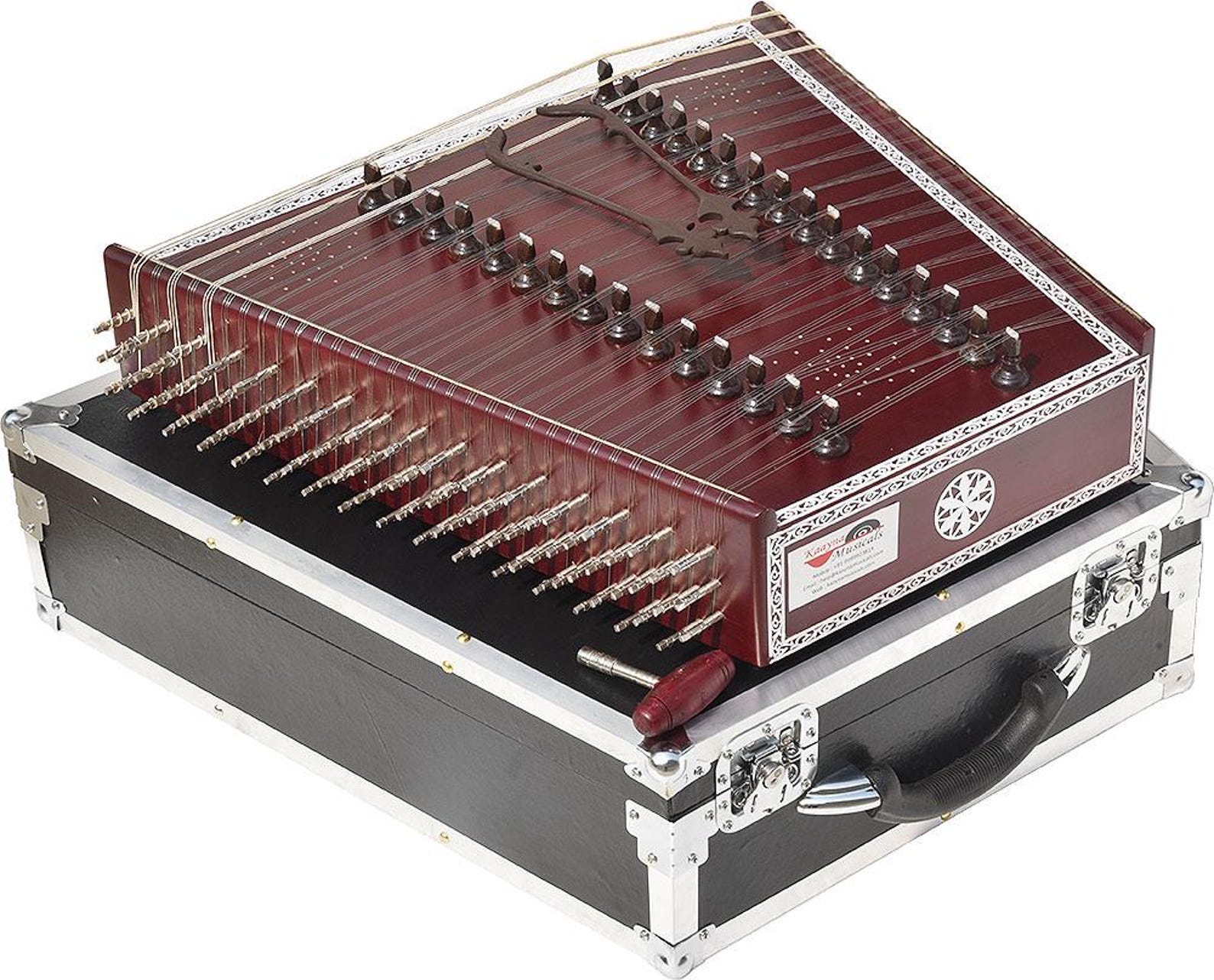
Instrument Profile
| Instrument Type | Indian Santoor |
| Style | Pt. Shiv Kumar Style |
| Skill Level | Intermediate |
| Bridges | 31 bridges |
| Strings | Approx. 93 strings (brass and steel) |
| Tuning System | Multi-octave (approx. 3 octaves) |
| Body Material | Indian wood / plywood |
| Finish | Matte, mahogany color |
| Dimensions | Approx. 24″ × 22″ × 4″ |
| Weight | Approx. 4 – 5 kg |
| Hammers (Mezrab) | 2 included |
| Accessories | Hard case, tuning key, extra strings |
Acoustic Characteristics
The Indian santoor, particularly in the style associated with Pandit Shiv Kumar Sharma, represents a distinct evolution of the hammered dulcimer tradition within the context of Hindustani classical music.
Unlike the Persian santur, the Indian santoor features a larger body, more bridges (typically around 30+), and a higher number of strings, allowing for an extended range and greater melodic flexibility. This structural expansion supports the development of raga performance, where sustained melodic exploration and intricate phrasing are essential.
The combination of brass and steel strings produces a bright, ringing tone with strong sustain, while the larger soundboard enhances projection and resonance. The sound is often described as shimmering and expansive, capable of both rhythmic articulation and flowing melodic lines.
A defining aspect of the Indian santoor tradition is the adaptation of technique to fit the aesthetics of Hindustani music. Through the work of musicians such as Pandit Shiv Kumar Sharma, the instrument was reconfigured to function as a fully expressive melodic instrument, capable of articulating raga structures rather than remaining primarily rhythmic.
Compared to Persian santur, the Indian santoor tends to emphasize sustain, projection, and linear melodic development, reflecting a different musical logic and performance context.
Strengths ✅
- Extended range due to 31 bridges and multiple strings
- Strong projection and sustain suitable for performance
- Well suited for Hindustani classical (raga) music
- Bright, resonant, and expressive tonal character
- Complete setup included
- Established design linked to a recognized performance tradition
Considerations ⚠️
- More complex layout compared to Persian santur or beginner models
- Requires developed technique for control and articulation
- Heavier and less portable than smaller santur
- Tuning can be time-consuming due to high number of strings
- Construction (plywood) may offer less tonal refinement than solid wood instruments
- Not interchangeable with Persian santur in terms of musical system
4) 12 Kharak Sadeghi Persian Santur

Instrument Profile
| Instrument Type | Persian Santur |
| Skill Level | Intermediate |
| Wood | Walnut |
| Bridges (Kharak) | 12 bridges |
| Strings | Steel and Bronze |
| Bridge Material | Walnut |
| Dimensions | 100 × 35 × 10 cm |
| Weight | Approx. 4.5 kg |
| Decoration | Khatam and Moragh inlays |
| Hammers (Mezrab) | 2 included |
| Accessories | Hard case, extra strings, tuning wrench |
Acoustic Characteristics
This 12 kharak Persian santur, crafted by Sadeghi, represents a more developed form of the instrument compared to beginner models, offering greater range and modal flexibility within the framework of Persian classical music.
The walnut body provides a deep and balanced resonance, supporting both warmth and sustain. The combination of steel and bronze strings creates a layered tonal response: bronze strings contribute roundness and warmth, while steel strings add brightness and clarity, resulting in a rich and articulated sound spectrum.
With its 12-bridge configuration, this santur allows access to a broader set of pitches and modulations compared to 9-bridge instruments. This is essential for navigating the dastgah system, where shifting between modal spaces requires structural flexibility across the instrument.
The sound is resonant, detailed, and dynamically responsive, capable of both rhythmic precision and expressive melodic phrasing. Compared to simpler santur, this instrument offers greater sustain, tonal depth, and control, supporting more advanced repertoire.
From a broader perspective, instruments of this type sit closer to the core practice of Persian classical music, where the santur functions not only as a melodic instrument but as a structural voice within the radif tradition.
The presence of khatam and moragh inlays reflects a long-standing integration of visual artistry and instrument making, where craftsmanship extends beyond sound into aesthetic expression.
Strengths ✅
- 12-bridge configuration allows greater modal flexibility
- Walnut body provides rich, warm, and balanced resonance
- Combination of steel and bronze strings enhances tonal complexity
- Suitable for advanced radif and dastgah performance
- High-quality handcrafted construction by an experienced maker
- Decorative inlays reflect traditional craftsmanship
- Complete professional setup included
Considerations ⚠️
- More complex layout than beginner santur
- Requires developed technique and modal understanding
- Heavier and less portable than entry-level instruments
- Tuning is more demanding due to increased string count
- Not ideal for beginners without guidance
Best Professional Santur
5) 14 Kharak Persian Santur MAS-414

Instrument Profile
| Instrument Type | Persian Santur |
| Skill Level | Advanced / Professional |
| Wood | Walnut |
| Bridges (Kharak) | 14 bridges |
| Strings | Not Specified |
| Bridge Material | Walnut |
| Dimensions | 108 × 38 × 8 cm |
| Hammers (Mezrab) | 2 included |
| Accessories | Hard case, extra strings, tuning wrench |
Acoustic Characteristics
This 14 kharak santur, crafted by Hamid Mousavi, represents a fully developed professional instrument, designed to support the complexity and flexibility required in Persian classical performance.
The walnut body provides a deep, resonant, and well-balanced tonal foundation, allowing the instrument to sustain both low and high registers with clarity. Compared to 9 or 12 bridge santur, the 14-bridge configuration significantly expands the available pitch range, enabling more fluid navigation across different modal spaces within the dastgah system.
This structural expansion allows for greater modulation capacity, reducing the need for retuning and supporting more continuous melodic development. The result is a sound that is rich, layered, and dynamically responsive, capable of sustaining both intricate rhythmic passages and extended melodic lines.
At this level, the santur becomes not only a melodic instrument, but a highly flexible modal system in itself, where the spatial organization of strings directly reflects musical logic.
Compared to intermediate instruments, this model offers increased sustain, tonal depth, and precision, requiring and rewarding a higher degree of technical control.
Within its context, this type of santur is closely aligned with professional radif performance, where nuance, timing, and tonal control are central.
Strengths ✅
- 14-bridge configuration allows maximum modal flexibility
- Extended range suitable for advanced dastgah exploration
- Walnut body provides deep resonance and tonal balance
- High level of responsiveness and dynamic control
- Suitable for professional performance contexts
- Handcrafted by an experienced luthier
- Complete professional setup included
Considerations ⚠️
- Requires advanced technical and theoretical knowledge
- More complex layout than 9 or 12 bridge santur
- Tuning and maintenance are more demanding
- Heavier and less portable
- Not suitable for beginners
6) Indian Professional Santoor

Instrument Profile
| Instrument Type | Indian Santoor |
| Style | Pt. Shiv Kumar Style |
| Skill Level | Advanced / Professional |
| Bridges | 31 bridges (Sheesham wood with bone edges) |
| Strings | Approx. 94 strings |
| Tuning System | Multi-octave (raga-based) |
| Top & Base | Teak wood |
| Sides | Mulberry wood |
| Frame | Cedar wood |
| Hammers (Mezrab) | Walnut wood |
| Decoration | Celluloid inlay |
| Case | Thermo-fiber hard case |
Acoustic Characteristics
This Rikhiram Santoor, built in the style of Pandit Shiv Kumar Sharma, represents a more structurally refined and acoustically developed version of the Indian santoor compared to entry-level models.
The combination of teak (top and base), mulberry (sides), and cedar (frame) creates a complex and well-balanced resonance. Teak contributes to stability and sustain, mulberry adds warmth, while cedar supports structural lightness and responsiveness. This layered construction results in a tone that is both resonant and controlled, with clear separation between registers.
With its 31 bridges and 90+ strings, the instrument offers a wide melodic range and sustained tonal field, essential for the development of raga performance. The bone-edged bridges enhance string definition and articulation, contributing to a precise and articulate attack, especially important in fast passages and intricate phrasing.
Compared to simpler santoor, this model provides:
- greater sustain and projection
- more refined tonal balance
- increased dynamic control
Within the Hindustani tradition, this type of instrument supports a playing style where the santoor is treated as a fully expressive melodic instrument, capable of unfolding long-form improvisation (alap, jor, jhala) as well as rhythmic compositions.
Strengths ✅
- High-quality multi-wood construction for balanced resonance and stability
- 31-bridge system supports full raga performance practice
- Bone-edged bridges improve clarity and articulation
- Strong sustain and projection
- Faithful to a well-established performance model (Pt. Shiv Kumar Sharma style)
- Suitable for advanced and professional players
- Durable thermo-fiber case included
Considerations ⚠️
- Complex layout requiring advanced technical control
- Tuning is time-intensive due to high string count
- Heavier and less portable than simpler santur
- Not suitable for beginners
- Differences in craftsmanship may occur due to handmade nature
7) Santur With Mandals (Latches) KMS-404

Instrument Profile
| Instrument Type | Persian Santur (modified, with mandal system) |
| Skill Level | Advanced |
| Wood | Walnut |
| Bridges (Kharak) | 9 bridges |
| Strings | Not Specified |
| Dimensions | 106 × 29 × 8 cm |
| Tuning System | Mandal (latch) system for pitch adjustment |
| Mechanism | Lever-based micro-adjustment (qanun-like) |
| Hammers (Mezrab) | 2 included |
| Accessories | Hard case, extra strings, tuning wrench |
Acoustic Characteristics
This instrument represents a hybrid adaptation of the Persian santur, integrating a mandal (latch) system similar to that used in the qanun, a plucked zither from Middle Eastern traditions.
Structurally, it retains a 9-bridge layout, typical of more compact santur configurations, but introduces a system of mechanical pitch levers that allow the player to alter string tuning quickly and with precision. This makes it possible to navigate between different modal configurations (maqam or dastgah) without retuning the instrument manually.
Acoustically, the walnut body provides a warm and balanced resonance, while the presence of the mandal system shifts the instrument’s function toward greater flexibility and responsiveness in modulation.
Compared to traditional santur:
- standard models require manual retuning or repositioning strategies
- this model allows real-time pitch adjustment
However, this innovation also introduces a conceptual shift. The santur, traditionally organized around fixed spatial relationships, becomes a more mechanically adaptable instrument, closer in logic to instruments like the qanun.
The sound itself remains clear and articulated, but the emphasis moves from structural limitation to modal fluidity and immediacy.
Strengths ✅
- Mandal system allows fast and precise pitch adjustment
- Enables easier navigation between maqam/dastgah systems
- Reduces need for manual retuning
- Walnut body provides warm and balanced tone
- Combines traditional structure with modern flexibility
Considerations ⚠️
- Mandal system allows fast and precise pitch adjustment
- Enables easier navigation between maqam/dastgah systems
- Reduces need for manual retuning
- Walnut body provides warm and balanced tone
- Combines traditional structure with modern flexibility
Final Considerations
The Santur is part of a broader musical ecosystem shaped by history, community, and lived practice. Approaching it with curiosity, patience, and respect allows musicians to engage not only with an instrument, but with the cultures and traditions that sustain it.
This guide is intended as a starting point—an invitation to listen, learn, and continue exploring the Santur through study, practice, and connection with the music and musicians who keep its traditions alive.
“This article is written from an educational perspective, with the aim of supporting respectful access for learners and musicians worldwide. It does not replace the knowledge transmitted within the communities where the Santur originates, but seeks to provide context, orientation, and care when approaching the instrument.”
Tag:Strings
