
7 Best Sitars (2026) – Buyer’s Guide for Beginners & Professionals
Disclosure: This article may contain affiliate links. If you buy through these links, we may earn a commission at no additional cost to you.
The sitar is one of the most recognizable instruments of the Indian subcontinent and a central voice within Hindustani classical music, the North Indian art music tradition. Known for its shimmering resonance and highly expressive melodic language, the instrument occupies a space where craftsmanship, musical theory, and performance practice intersect.
Over the past century, the sitar has also become one of the most globally recognized symbols of Indian music. Through the work of musicians such as Ravi Shankar, its sound reached international audiences and influenced artists far beyond the classical tradition. Yet behind its global visibility lies a sophisticated musical system shaped by centuries of cultural exchange across South Asia and the Persianate world.
This guide explores the instrument’s historical development, construction, musical role, and practical considerations for choosing a sitar, concluding with a curated selection of instruments for beginners and advanced players.
Table of Contents

Historical Development of the Sitar
The sitar emerged in North India between the 16th and 18th centuries, during a period of intense cultural exchange within the Mughal courts. While earlier narratives sometimes attribute the instrument’s invention to the 13th century, most musicologists consider it the result of a gradual evolution influenced by earlier long-necked lutes such as the Persian setar and various regional Indian instruments.
The name itself reflects this intercultural history. Derived from the Persian “sehtar” (“three strings”), the term originally referred to a different instrument but gradually became associated with the evolving North Indian lute that would become the sitar.
By the late nineteenth and early twentieth centuries, the sitar had become firmly established in Hindustani classical music, where it developed a highly sophisticated performance tradition based on the melodic frameworks known as rāgas. These structures define not only the scale of a composition but also characteristic melodic movements, emotional atmospheres, and performance contexts.
The global recognition of the sitar arrived in the twentieth century through musicians such as Ravi Shankar and Vilayat Khan, whose recordings and international tours introduced the instrument to audiences across Europe and North America. During the 1960s the sitar even entered Western popular culture, appearing in rock and psychedelic music, most famously in The Beatles’ “Norwegian Wood.”
Despite these cross-cultural moments, the sitar remains fundamentally rooted in the long-form improvisational traditions of Hindustani classical music, where mastery requires years of apprenticeship within the guru–shishya lineage system.
How the Sitar Produces Its Sound
The sitar’s distinctive sound arises from a complex interaction between melody strings, sympathetic resonance, and flexible frets.
The instrument is built around a long hollow neck attached to a resonating gourd, traditionally carved from tumba (dried gourd) and hardwoods such as teak or tun. Along the neck runs a series of arched, movable metal frets, tied with silk or nylon threads. Because these frets can be adjusted, musicians can adapt the instrument to different rāgas and microtonal inflections.
Most sitars include 18–21 strings, though only a small number are directly played. The main melody strings are plucked with a metal plectrum known as a mizrab, worn on the index finger. Beneath them lies a set of sympathetic strings (taraf) that vibrate in response to the notes played above. This sympathetic resonance produces the characteristic shimmering halo of sound that surrounds each melodic phrase.
A defining element of the sitar’s sound is the jawari, the curved bridge that shapes the vibration of the strings. This design produces the characteristic buzzing, sustained overtone that gives the instrument its shimmering quality. The adjustment of the jawari is a specialized process and plays a crucial role in the tonal identity of each instrument.
A key expressive technique of sitar performance is meend, a long pitch glide achieved by pulling the string laterally across the curved fret. This allows performers to move fluidly between notes, creating melodic shapes that reflect the expressive vocabulary of Indian rāga performance.
The result is a sound that is simultaneously precise, fluid, and richly resonant, capable of sustaining both delicate melodic lines and dramatic improvisational passages.
Major Styles of Sitar
Over the twentieth century, two principal stylistic approaches to sitar construction and performance became widely recognized.
The Ravi Shankar (Kharaj Pancham) style uses a larger instrument with a deeper tonal register and a greater number of sympathetic strings. This configuration supports a broader melodic range and emphasizes the expansive improvisational structures typical of Shankar’s performance tradition.
The Vilayat Khan (Gandhar Pancham) style, by contrast, uses fewer sympathetic strings and prioritizes a vocal-like melodic approach known as gayaki ang, which attempts to imitate the expressive phrasing of classical singing.
Both traditions represent different interpretative philosophies rather than rigid technical categories, and many modern instruments combine elements of both designs.
Rāga and Tāla: The Musical Framework
Within Hindustani classical music, the sitar is typically performed within the dual framework of rāga and tāla. A rāga is not simply a scale but a melodic system that defines characteristic note patterns, emotional atmosphere, and rules for improvisation. Performers gradually unfold a rāga through structured improvisation, shaping phrases that reveal its identity over time. The rhythmic dimension is organized through tāla, cyclical patterns of beats that guide the interaction between melody and percussion, often performed on the tabla. Together, rāga and tāla form the conceptual architecture of North Indian classical performance, within which the sitar develops its expressive language.
Choosing the Best Sitar: A Beginner’s Guide
Selecting a sitar requires attention not only to technical specifications but also to the instrument’s acoustic character.
The most important factor is always sound quality. Each sitar resonates differently depending on the craftsmanship of the gourd, the quality of the wood, and the precision of the frets and bridges. An instrument that produces a balanced tone across both melody and sympathetic strings will allow the performer to fully explore the subtle dynamics of rāga performance.
Other factors to consider include:
- Level of Ability: For beginners, simpler instruments with fewer decorative elements can be easier to maintain and tune. Professional instruments, by contrast, often involve more intricate carving and refined acoustic adjustments, reflecting the work of specialized luthiers.
- Materials: Construction materials play a crucial role in shaping the sitar’s sound and stability. Hardwoods such as tun, teak, or mahogany provide a warm and stable tonal foundation, while the gourd resonator (tumba) enhances depth and projection. The bridge, typically made from bone or synthetic materials, shapes the characteristic jawari and sustain, and the steel and brass strings contribute to the instrument’s brightness and rich resonance.
- Price: Prices vary widely depending on craftsmanship and materials. Entry-level instruments may begin around €300–€600, while high-quality concert sitars produced by respected workshops can exceed €1000 or more.
- Accessories: Accessories such as a mizrab, spare strings, and a protective case are also essential for proper maintenance and performance.
Types of Sitar
| Type | Characteristics | Best For |
| Study / Travel Sitar | Wooden body, lighter, simplified resonance | Beginners, portability |
| Single Tumba Sitar | Traditional design with one gourd | Students and intermediate players |
| Double Tumba Sitar | Two gourds, enhanced resonance | Advanced and professional players |
| Electric / Semi-Acoustic Sitar | Built-in pickup | Amplified and fusion contexts |
How to Choose Your First Sitar
Choosing your first sitar involves not only evaluating sound quality and materials, but also understanding how different instrument designs relate to your learning context and practical needs.
One of the first decisions concerns the type of construction. Fully wooden sitars, often used in study or travel models, offer greater durability and ease of transport, making them suitable for beginners who need a more manageable instrument. Traditional sitars with a gourd resonator, on the other hand, provide a richer and more expansive sound, but require more careful handling and maintenance.
Another key factor is the instrument’s configuration and complexity. While most sitars share a similar number of strings, variations in setup, such as simplified layouts or reduced resonance systems, can make certain models more accessible in the early stages. More elaborate instruments, including double tumba designs, are generally better suited to players who are already familiar with tuning and basic control.
Physical dimensions and ergonomics should also be considered. The sitar is a relatively large instrument, and differences in weight, neck length, and resonance structure can significantly affect comfort during practice. Choosing a model that feels manageable will support longer and more consistent playing sessions.
Finally, it is important to think in terms of progressive learning rather than immediate perfection. A first sitar should provide a stable and responsive platform for developing listening skills and basic control, without introducing unnecessary complexity. As familiarity with the instrument grows, transitioning to more refined models becomes a natural next step.
The following selection reflects these criteria and aims to support both beginners and advanced players in making an informed choice.
The 7 Best Sitar
Best Sitar for Beginners
1) Vilayat Khan Style, Study Sitar

Instrument Profile
| Style | Vilayat Khan (Gayaki style) |
| Main Strings | 6 |
| Total Strings | Typically 17–23 (including sympathetic strings) |
| Body Material | Tun wood (complete wooden construction) |
| Resonator | Wooden body (no traditional gourd) |
| Length | approx. 43 inches |
| Weight | approx. 4–5 kg |
| Electronics | Can be connected to an amplifier |
| Accessories Included | Extra strings, mizrabs, fiber hard case or carry bag |
| Construction | Handmade |
Acoustic Characteristics
The Vilayat Khan style sitar is designed to emphasize a more vocal-like (gayaki) expression, favoring melodic nuance and fluid phrasing over the more percussive attack found in other sitar styles. With 6 main strings, the instrument allows for a streamlined playing approach focused on melodic clarity and expressive ornamentation.
The fully wooden body (rather than a traditional gourd resonator) produces a more focused and controlled tone, with slightly less natural resonance but improved portability and stability. The sympathetic strings vibrate in response to played notes, adding a rich harmonic resonance and depth to the overall sound.
When amplified, the instrument can project more clearly in modern performance contexts, making it suitable for fusion, studio work, and live amplification settings, while still retaining the characteristic shimmering sustain of the sitar.
Strengths ✅
- Vilayat Khan (gayaki) style supports expressive, vocal-like melodic playing
- Lightweight and portable compared to traditional gourd sitars
- Full wooden construction improves durability and travel convenience
- Can be connected to an amplifier for modern performance contexts
- Includes essential accessories (case, mizrabs, extra strings)
- Suitable for students and intermediate players
Considerations ⚠️
- Less natural acoustic resonance compared to traditional gourd-based sitars
- Handmade construction may include minor cosmetic imperfections
- Requires regular tuning and maintenance due to multiple strings
2) Ravi Shankar Style, Study Sitar
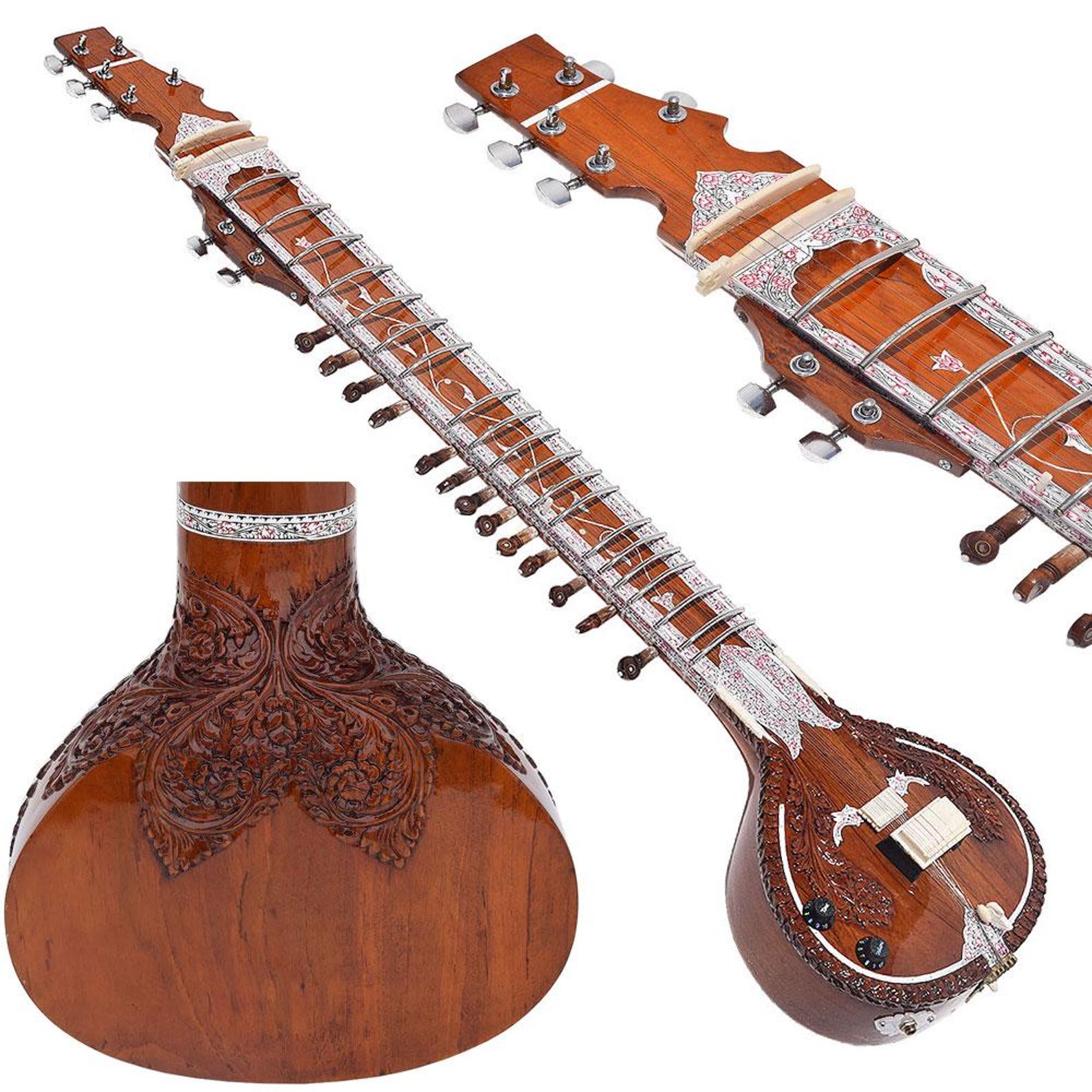
Instrument Profile
| Style | Ravi Shankar style |
| Main Strings | 7 |
| Total Strings | Typically 17–23 (including sympathetic strings) |
| Body Material | Tun wood (complete wooden construction) |
| Resonator | Wooden body (no traditional gourd) |
| Length | approx. 43 inches |
| Weight | approx. 5 kg |
| Electronics | Can be connected to an amplifier |
| Accessories Included | Extra strings, mizrabs, fiber hard case or carry bag |
| Construction | Handmade |
Acoustic Characteristics
The Ravi Shankar style study sitar is designed to deliver a rich, resonant, and structured tonal response, reflecting the traditional tantrakari (instrumental) approach associated with this style. With 7 main strings, the instrument supports both melodic development and rhythmic articulation, allowing for a broader expressive range compared to simplified study models.
The full wooden body produces a focused and controlled sound, with slightly less natural resonance than gourd-based sitars but improved durability and consistency, particularly useful for travel and amplified contexts. The sympathetic strings enhance the sound with a layered, shimmering resonance, contributing to the characteristic depth of the sitar.
The possibility of amplification adds versatility, making the instrument suitable for modern performance settings, recording, and fusion genres, while maintaining the essential tonal identity of the sitar.
Strengths ✅
- Ravi Shankar style supports a structured and expressive playing approach
- Full wooden construction increases durability and portability
- Amplification capability with volume and tone control
- Includes essential accessories (case, mizrabs, extra strings)
- Lightweight and suitable for travel and practice
- Handcrafted instrument with traditional aesthetic design
Considerations ⚠️
- Less acoustic resonance compared to traditional gourd sitars
- Handmade construction may include minor cosmetic imperfections
- Requires regular tuning due to multiple strings
- Not fully representative of high-end concert sitars in tonal complexity
3) Thomann Nataraj Sitar

Instrument Profile
| Style | Ravi Shankar style |
| Main Strings | 7 |
| Sympathetic Strings | 11 |
| Frets | 20 movable frets |
| Vibrating String Length | approx. 85.5 cm |
| Tuning Pegs | 2 fine tuners (upper) + 2 fine tuners (lower) |
| Resonator | Main gourd + detachable secondary gourd |
| Total Length | approx. 125 cm |
| Width | approx. 37 cm |
| Depth | approx. 32 cm |
| Decorations | Ornamental inlay work |
| Accessories Included | Gig bag with shoulder strap |
Acoustic Characteristics
The Thomann Nataraj Sitar (Ravi Shankar style) offers a rich, resonant, and highly expressive sound, characteristic of traditional Hindustani classical music. The presence of both a main gourd resonator and a secondary (detachable) gourd enhances the instrument’s natural resonance, producing a full-bodied tone with long sustain.
With 7 main strings and 11 sympathetic strings, the instrument generates a complex harmonic field. The sympathetic strings vibrate in response to played notes, creating the sitar’s signature shimmering, layered resonance. Compared to Vilayat Khan-style sitars, this configuration supports a more rhythmically articulated and structurally complex approach, often associated with instrumental (tantrakari) playing.
The movable frets allow for precise intonation and microtonal expression, essential for the melodic nuances of Indian classical music.
Strengths ✅
- Traditional Ravi Shankar style with full string configuration
- Rich resonance enhanced by dual gourd system
- 11 sympathetic strings provide complex harmonic depth
- Movable frets allow precise intonation and microtonal flexibility
- Includes gig bag for transport
- Suitable for students seeking an authentic traditional sitar
Considerations ⚠️
- Larger and less portable than fully wooden sitars
- Requires careful maintenance of gourds and strings
- More complex tuning due to higher number of strings
- Steeper learning curve compared to simplified study sitars
4) Thomann Nataraj Sitar for left-handed

Instrument Profile
| Orientation | Left-handed version |
| Style | Ravi Shankar style |
| Main Strings | 7 |
| Sympathetic Strings | 13 |
| Frets | 20 movable frets |
| Vibrating String Length | approx. 85.5 cm |
| Tuning Pegs | 7 carved wooden pegs + 2 fine tuners (upper) + 2 fine tuners (lower) |
| Resonator | Main gourd + detachable secondary gourd |
| Total Length | approx. 125 cm |
| Width | approx. 35 cm |
| Depth | approx. 32 cm |
| Decorations | Ornamental inlay work |
| Accessories Included | Gig bag with shoulder strap |
Acoustic Characteristics
The Thomann Nataraj Left-Handed Sitar (Ravi Shankar style) retains the full acoustic richness of traditional sitars while adapting the layout for left-handed players. The combination of a primary gourd resonator and a detachable secondary gourd produces a deep, resonant tone with long sustain, characteristic of classical Hindustani performance.
With 7 main strings and 13 sympathetic strings, the instrument generates a dense harmonic texture, where the sympathetic strings vibrate in response to played notes, creating the sitar’s signature shimmering resonance. This expanded sympathetic configuration enhances sustain and tonal depth.
The movable frets allow for precise intonation and microtonal flexibility, enabling expressive melodic phrasing. Overall, the instrument supports a balanced combination of melodic clarity and rich resonance, suitable for traditional repertoire.
Strengths ✅
- Left-handed design, rarely available in traditional instruments
- Full Ravi Shankar-style configuration with rich tonal depth
- Dual gourd system enhances resonance and sustain
- 13 sympathetic strings provide complex harmonic richness
- Movable frets allow precise intonation and expressive playing
- Includes gig bag for transport
Considerations ⚠️
- Limited availability compared to right-handed models
- Complex tuning due to high number of strings
- Larger and less portable than simplified sitar designs
- Requires careful maintenance of gourds and strings
Best Professional Sitar
5) Ravi Shankar Style, Professional Sitar

Instrument Profile
| Style | Ravi Shankar style |
| Main Strings | 7 |
| Total Strings | Typically 18–23 (including sympathetic strings) |
| Body Material | Tun wood |
| Resonators | Two gourds (main + upper tumba) |
| Finish | Polished with decorative inlay (Gulab Patta design) |
| Size | Medium |
| Construction | Handmade in India |
| Accessories Included | Mizrab, extra string set, fiber trolley hard case |
Acoustic Characteristics
The Ravi Shankar Style Professional Double Tumba Sitar is designed to produce a full, deep, and highly resonant sound, suitable for concert-level performance. The presence of two gourd resonators significantly enhances the instrument’s acoustic projection and sustain, creating a rich, enveloping tonal field.
The tun wood body provides a stable tonal foundation, while the sympathetic strings generate the characteristic shimmering harmonic resonance that defines the sitar’s sonic identity. Compared to single-resonator or fully wooden study models, the double tumba configuration offers greater depth, volume, and tonal complexity, especially in larger performance spaces.
This setup supports the tantrakari style, emphasizing both melodic development and rhythmic articulation, with a wide dynamic range and expressive capability.
Strengths ✅
- Professional-grade sitar with enhanced resonance and projection
- Double tumba design provides deeper, richer tonal response
- Handcrafted instrument reflecting traditional Indian craftsmanship
- Includes fiber trolley hard case for secure transport
- Rich harmonic texture thanks to sympathetic strings
- Suitable for advanced players and concert settings
Considerations ⚠️
- Larger and more fragile due to dual gourd construction
- Less portable compared to single-resonator or wooden sitars
- Requires careful maintenance and handling
- Complex tuning system due to high number of strings
- Handmade instruments may show natural variations in finish
6) Rikhi Ram Shop
Rikhi Ram Musical Instruments is one of the most historically significant and respected makers of Indian classical instruments, particularly known for its high-quality sitars crafted in the Ravi Shankar tradition. Based in India and active for decades, the workshop has built instruments for some of the most influential musicians in Hindustani classical music.
The sitars offered through their shop reflect a strong commitment to traditional craftsmanship, with features such as tun wood construction, carefully shaped gourds (tumba), and finely adjusted sympathetic strings that contribute to a rich and balanced tonal response. Their instruments are often associated with the Ravi Shankar style, emphasizing clarity, resonance, and expressive depth suitable for both solo performance and accompaniment.

Rikhi Ram sitars are typically positioned in the professional and high-end segment, making them particularly suitable for advanced students, performers, and collectors seeking instruments with historical lineage, tonal refinement, and artisanal quality. Their selection represents a direct connection to the evolution of the modern concert sitar.
7) Tablasitar.com
TablaSitar.com offers a wide selection of Indian classical instruments, with a particularly strong focus on sitar models for different levels of experience, from beginner-friendly study instruments to more refined professional configurations.
The sitars available on the platform typically include both Ravi Shankar (tantrakari) and Vilayat Khan (gayaki) styles, allowing players to choose based on their preferred musical approach. Materials such as tun wood bodies and traditional gourd resonators (single or double tumba) are commonly featured, contributing to the characteristic resonance and tonal depth of the instrument.
The store places emphasis on functional, performance-ready instruments, often including essential accessories such as mizrabs, extra strings, and protective cases, making them suitable for both practice and stage use.

While many models are positioned in the accessible to mid-range category, the variety of configurations allows players to explore different tonal characteristics and structural designs.
Overall, TablaSitar.com represents a practical resource for musicians seeking affordable and versatile sitars, with options that support both initial learning and progression into more advanced playing contexts.
Final Considerations
The sitar represents far more than a musical instrument. It is part of a living musical system shaped by centuries of artistic exchange, spiritual philosophy, and disciplined training. Within Hindustani classical music, the sitar serves as a vehicle for exploring the subtle emotional landscapes of rāga, where melody unfolds gradually through improvisation and deep listening.
To approach the sitar responsibly therefore means understanding not only its construction but also the musical tradition that gives it meaning.
“This article is written from an educational perspective for a global audience. It does not replace the knowledge transmitted within distinct traditions, and readers are encouraged to seek information directly from original sources whenever possible.”
Tag:Strings
