
7 Types of Tanbur Instruments (2026 Guide)
Disclosure: This article may contain affiliate links. If you buy through these links, we may earn a commission at no additional cost to you.
The word tanbur does not refer to a single instrument, but to a family of long-necked lutes that have developed across the Middle East, Anatolia, the Balkans, Central Asia, and South Asia. Over centuries, the instrument took different shapes, tunings, techniques, and cultural meanings, while preserving a shared structural idea: a resonant body, a long neck, and strings capable of articulating modal systems beyond Western tonality.
It is essential to understand the tanbur as a living instrument shaped within distinct musical and spiritual traditions, Persian, Kurdish, Ottoman, Balkan, Central Asian, and Indian, each grounded in its own history, repertoire, and aesthetic logic.
This guide explores the historical development of the tanbur family, clarifies the differences between its major variants, explains how it works from a technical perspective, and offers practical orientation for those who wish to approach one responsibly.
Table of Contents

The History of the Tanbur
Tanbur: One Name, Many Instruments
The word tanbur often creates confusion because it does not refer to a single standardized instrument. Across Eurasia, the name, in forms such as tanbur, tambur, tambura, or tanpura, has been used for a wide family of long-necked lutesthat developed in different musical cultures.
Although these instruments share historical and structural connections, they evolved within distinct musical systems, repertoires, and performance traditions. Understanding these differences helps clarify why instruments that carry similar names can sound, look, and function very differently.
The table below summarizes some of the most commonly encountered instruments within the broader tanbur family.
| Instrument | Region | Strings | Musical Role |
| Persian / Kurdish Tanbur | Western Iran, Kurdistan | 2–3 strings | Devotional and folk repertoire, modal melodic playing |
| Turkish Tambur | Turkey (Ottoman classical tradition) | 7–8 metal strings | Makam-based art music, solo improvisation (taksim) |
| Balkan Tambura | Balkans (North Macedonia, Bulgaria, Serbia) | 4–8 strings | Ensemble folk music, rhythmic and harmonic support |
| Uzbek Tanbur | Central Asia | 4–6 strings | Court and classical repertoire, melodic performance |
Historical Roots and Cultural Trajectories
Archaeological evidence suggests that long-necked lutes related to the tanbur family were already present in ancient Mesopotamia during the third millennium BCE. Reliefs and iconographic sources from this period depict instruments with elongated necks and small resonating bodies, features that would later become characteristic of a wide family of Eurasian lutes.
Over centuries these instruments circulated through trade networks, migration, and imperial expansion, gradually spreading across Western and Central Asia. By the early medieval period, long-necked lutes were firmly established within the Persian cultural sphere, where written sources begin to mention instruments whose names resemble the modern tanbur.
The term itself is generally traced to Persian linguistic roots, and over time it generated related names such as tanbur, tambur, and tambura. While the terminology reflects historical connections between regions, the instruments themselves developed along distinct musical trajectories.
Understanding the Instrument Family
In western Iran and Kurdish regions, the tanbur acquired a strong spiritual dimension. Within the devotional practices of the Ahl-e Haqq (Yarsan) community, it accompanies sacred hymns and spiritual poetry and is often regarded as a vessel of spiritual expression rather than merely a musical instrument.
Further west, in Ottoman Anatolia, the tambur evolved into one of the most refined instruments of Ottoman art music. Its extremely long neck and carefully positioned frets allow performers to articulate the microtonal intervals of the makam system with remarkable precision, making it central to melodic improvisation (taksim) and classical ensemble performance.
Across the Balkan regions, related instruments such as the tambura entered folk ensemble traditions, where they typically provide rhythmic drive and harmonic texture within dance music.
In Central Asia, comparable long-necked lutes such as the Uzbek tanbur and the Kazakh dombra became closely associated with epic storytelling traditions, accompanying sung poetry and narrative performance.
In South Asia, the tanpura followed a very different path. Rather than functioning as a melodic instrument, it became the drone instrument of Indian classical music, sustaining the tonal foundation upon which raga performance unfolds.
Despite their shared linguistic ancestry, these instruments represent distinct musical traditions shaped by different historical and cultural contexts. The word tanbur therefore refers not to a single unified instrument, but to a family of related lutes whose forms and musical roles evolved across regions and centuries.
Anatomy of the Tanbur
Despite the diversity of instruments grouped under the tanbur name, most share a recognizable structural framework typical of long-necked lutes.

The instrument consists of a resonating body (bowl), a long neck, a soundboard, and a set of strings stretched between the nut and the bridge. The bowl may be carved from a single block of wood, as is common in Persian and Kurdish tanburs, or assembled from wooden ribs, as often seen in Turkish tamburs. Tonewoods such as mulberry, walnut, spruce, or juniper are frequently used because of their acoustic responsiveness.
The neck is typically long and narrow, allowing the placement of numerous frets. In many traditions these frets are movable or tied, enabling performers to adjust the precise location of intervals required by regional modal systems.
Strings vary depending on the tradition and instrument type. Some tanburs use gut, nylon, or synthetic strings, while others, particularly the Turkish tambur, commonly employ metal strings, producing a brighter and more projecting tone.
How the Tanbur Produces Sound
The tanbur is generally played as a plucked instrument, using either the fingers or a plectrum known as a mizrab in Persian and Turkish musical contexts. When the strings are plucked, their vibrations travel through the bridge to the soundboard and resonating body, amplifying the sound.
One of the defining characteristics of many tanbur traditions is the use of microtonal fret placement, which allows performers to produce intervals outside the equal-tempered tuning system common in Western music. These subtle pitch relationships are fundamental to modal frameworks such as the Persian dastgah and the Turkish makam.
Rather than emphasizing harmonic progression, tanbur performance typically focuses on modal exploration and melodic nuance. Sustained tones, ornamentation, subtle pitch inflections, and flexible rhythmic phrasing all contribute to the expressive language of the instrument.
Choosing the Best Tanbur: A Beginner’s Guide
Selecting a tanbur should begin not with price or decoration, but with clarity about musical direction.
Different traditions require different instruments. A Turkish tambur designed for Ottoman classical music will not serve the same function as a Kurdish tanbur used in sacred gatherings, nor will a tanpura substitute for a melodic lute.
Other factors to consider include:
- Sound: Sound response and intonation stability are essential. The instrument should sustain clearly, articulate ornaments cleanly, and maintain tuning consistency along the neck. Poorly constructed instruments often suffer from unstable frets, weak projection, or imprecise intonation, issues that become especially problematic in microtonal systems
- String Type: Metal strings are brighter, nylon strings are softer and easier for beginners.
- Neck Type: For beginners, it may be better to start with a Tanbur with fixed frets to get familiar with finger positions.
- Build Quality: A well-built entry-level tanbur from a reputable luthier is preferable to a decorative but acoustically compromised model.
- Budget: There are entry-level Tanburs for beginners, but be cautious: very low prices often correspond to poor-quality materials.
Above all, the choice of instrument implies the choice of musical language. The tanbur does not exist independently of the modal systems it serves.
Student vs Professional Tanbur
When choosing a tanbur, the distinction between student instruments and professional models is less about appearance and more about construction precision, materials, and acoustic response.
Student tanburs are generally designed to make the instrument accessible to beginners. They often use more readily available tonewoods and simpler construction methods. While they can still provide a pleasant sound and reliable playability, the tonal depth and responsiveness may be more limited compared to higher-end instruments. For someone starting to explore Persian, Kurdish, or Turkish repertoire, however, a well-built student instrument is usually more than sufficient.
Professional tanburs, by contrast, are typically crafted by experienced luthiers using carefully selected and aged tonewoods. Greater attention is given to details such as the shaping of the bowl, the placement and stability of frets, and the overall balance of the instrument. These factors influence not only the richness of the tone but also the instrument’s ability to respond to subtle changes in articulation and dynamics.
Another difference often lies in playability and tuning stability. High-quality pegs, precisely positioned frets, and a well-balanced neck allow professional instruments to maintain more accurate intonation and smoother performance across the instrument’s full range.
For beginners, the most important priority is finding an instrument that feels comfortable to play and produces a clear, stable tone. As technique develops and musical understanding deepens, many players eventually transition to a more refined instrument that allows greater expressive control.
Top 7 Tanbur to Buy
Best Tanbur for Beginners
1) Turkish Tanbur for Beginners
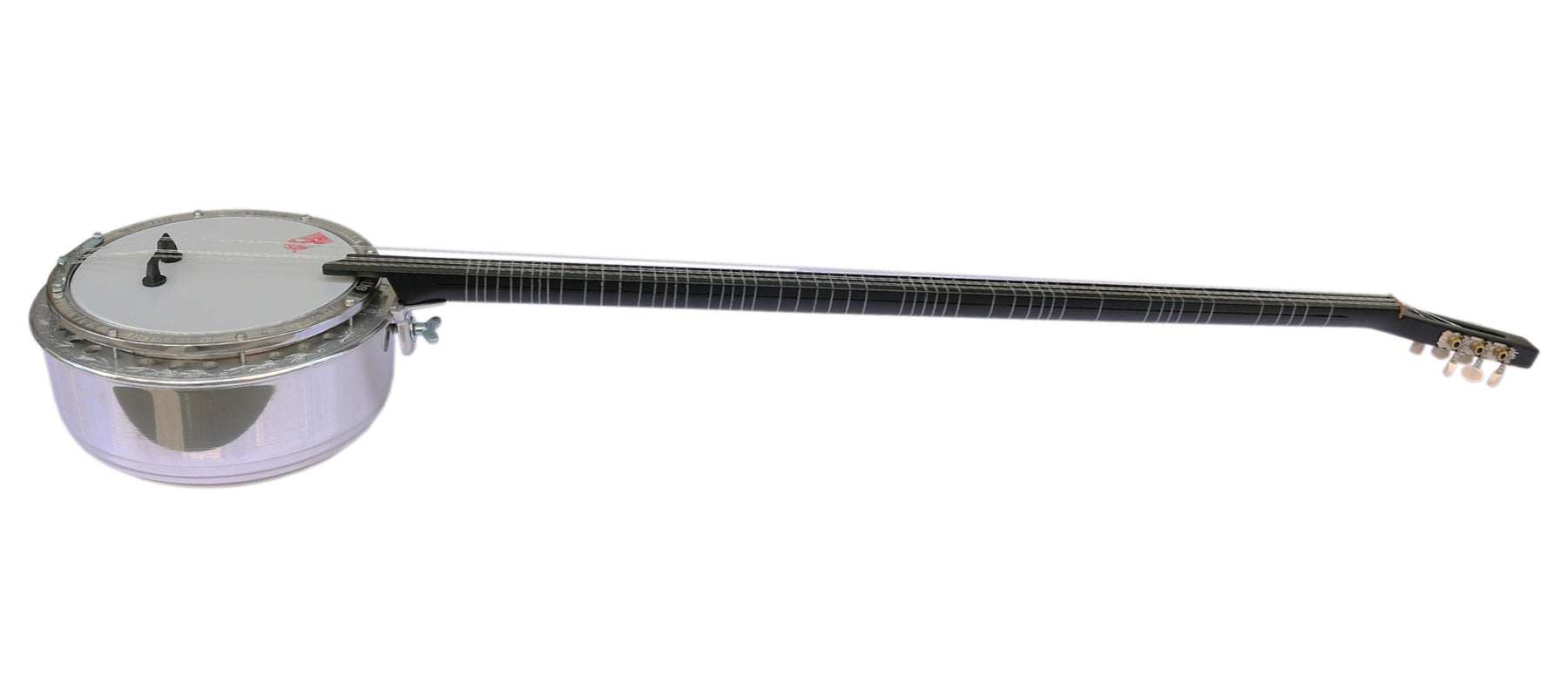
Instrument Profile
| Instrument Type | Turkish tanbur |
| Maker | Abidin İlhan Cümbüş |
| Body Material | Aluminum resonator body |
| Neck | Long fretless neck |
| Strings | Typically 6–7 strings |
| Tuning | Varies depending on repertoire |
Acoustic Characteristics
The Turkish cümbüş tanbur represents a modern adaptation of the traditional tanbur, one of the most important long-necked lutes in Ottoman classical music. The historical tanbur is known for its extremely long neck, movable frets, and delicate microtonal precision, making it particularly suited to the modal system of Turkish makam music.
The cümbüş version, developed in the early 20th century by the Cümbüş family of instrument makers, modifies the traditional design by replacing the wooden resonator with a metal bowl and membrane head, similar to the structure of a banjo. This innovation dramatically increases volume and projection, making the instrument suitable for larger ensembles and modern performance contexts.
Because of its brighter and more penetrating sound, the cümbüş tanbur has been used in Turkish urban music, folk ensembles, and experimental settings, where its metallic resonance contrasts with the warmer tone of the traditional wooden tanbur. The instrument maintains the long-neck playing technique and modal flexibility of the tanbur while offering a more powerful and amplified acoustic presence.
Strengths ✅
- Strong projection thanks to the aluminum resonator and membrane head
- Suitable for ensemble playing where higher volume is needed
- Maintains the long-neck structure required for makam-based performance
- Durable metal body less sensitive to humidity and temperature changes
Considerations ⚠️
- The metallic resonance differs significantly from the warm tone of traditional wooden tanburs
- Some players of Ottoman classical music may prefer the subtler sound of the historical instrument
- Setup and tuning may vary depending on repertoire and playing tradition
2) Persian Tanbur for Beginners

Instrument Profile
| Instrument Type | Persian tanbur |
| Bridge to Nut (Scale Length) | 72 cm |
| Bowl Diameter | 39 cm |
| Bowl Wood | Mulberry |
| Soundboard | Mulberry |
| Neck | Walnut |
| Construction | Long-necked lute with fixed frets |
| Included Accessories | Soft case, extra strings |
Acoustic Characteristics
The Persian tanboor (tanbur) is a long-necked lute deeply associated with the musical and spiritual traditions of Kurdish regions of western Iran, particularly in the context of Ahl-e Haqq (Yarsan) ritual music. Unlike the Ottoman tanbur used in Turkish classical music, the Persian tanboor typically has a smaller pear-shaped bowl and fixed frets, reflecting its role within regional modal traditions and devotional repertoires.
Historically, the instrument has been central to the performance of sacred hymns known as kalâm, where music functions as a vehicle for spiritual expression and communal memory. Over time, the tanboor has also entered concert and contemporary folk contexts, where musicians explore its distinctive tonal character within broader Kurdish and Persian musical landscapes.
The combination of mulberry wood for the bowl and soundboard contributes to a warm and resonant timbre, while the long scale length (72 cm) allows for clear articulation and strong projection. The instrument’s fretted neck supports the modal structures characteristic of Kurdish and Iranian traditions, where melodic phrasing and subtle ornamentation play an essential role.
Strengths ✅
- Traditional construction using mulberry and walnut, woods commonly used in Persian lute making
- Long scale length offering clear articulation and strong resonance
- Suitable for exploring Kurdish and Persian tanboor repertoire
- Includes essential accessories such as soft case and spare strings
Considerations ⚠️
- Playing technique and modal understanding often require guidance from specialized teachers or recordings
- Fixed frets mean the instrument follows a specific tuning system, which may differ from other Middle Eastern lutes
- The repertoire is strongly connected to regional and spiritual traditions, which may require contextual study to fully appreciate
3) Persian High Quality Tanbur

Instrument Profile
| Instrument Type | Persian tanbur |
| Maker | Mehrab |
| Bridge to Nut (Scale Length) | 68 cm |
| Bowl Diameter | 36 cm |
| Bowl Wood | Mulberry |
| Soundboard | Mulberry |
| Neck | Walnut |
| Construction | Long-necked lute with fixed frets |
| Included Accessories | Soft case, extra strings |
Acoustic Characteristics
Structurally, this instrument features a pear-shaped bowl carved from mulberry wood, paired with a long walnut neck fitted with tied or fixed frets. The mulberry soundboard contributes to the warm, focused resonance that characterizes the instrument’s sound. Compared to many other Middle Eastern lutes, the tanbur produces a tone that balances clarity, sustain, and subtle overtones, making it particularly effective for modal melodies and repetitive patterns used in ritual and contemplative performance.
With a scale length of 68 cm, this instrument falls within the common range for Persian tanburs, allowing comfortable playability while maintaining the tonal depth associated with the instrument’s traditional repertoire.
Strengths ✅
- Traditional tonewood combination (mulberry bowl and face with walnut neck) commonly used in Persian tanbur construction
- Balanced scale length offering comfortable playability and clear projection
- Suitable for musicians interested in Kurdish, Persian, and spiritual tanbur repertoire
- Includes practical accessories such as soft case and spare strings
Considerations ⚠️
- The instrument’s repertoire is closely tied to specific regional traditions, which may require study of modal structures and ornamentation
- Beginners may benefit from guidance through teachers or specialized recordings to understand traditional playing techniques
- Like many wooden instruments, proper humidity and temperature care helps maintain tuning stability and longevity
Best Professional Tanbur
4) Electro-Acoustic Persian Tanbur
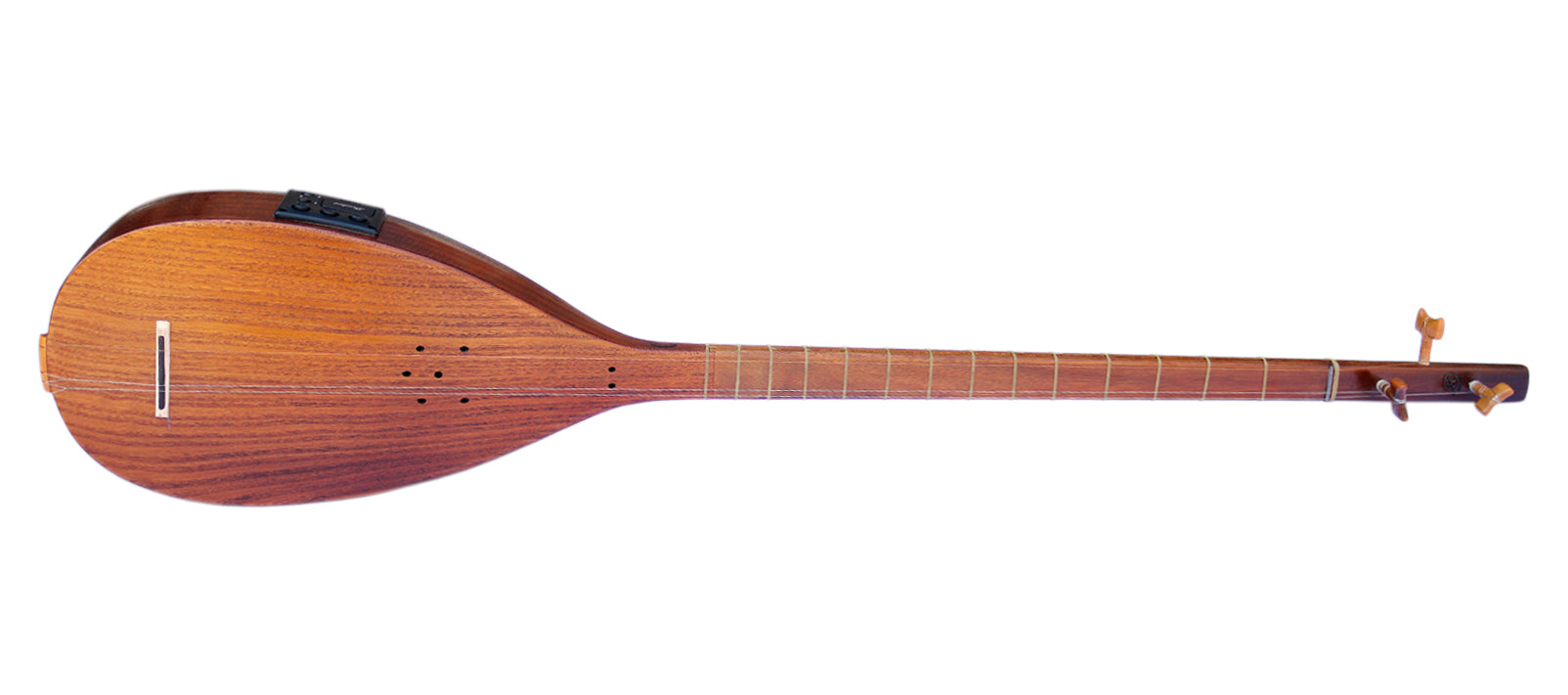
Instrument Profile
| Instrument Type | Electric Acoustic Persian Tanbur |
| Maker | Mehrab |
| Bridge to Nut (Scale Length) | 68 cm |
| Bowl Diameter | 36 cm |
| Bowl Wood | Mulberry |
| Soundboard | Mulberry |
| Neck | Walnut |
| Electronics | Shadow equalizer / pickup system |
| Construction | Acoustic-electric long-neck lute |
| Included Accessories | Soft case, extra strings |
Acoustic Characteristics
This electric-acoustic version preserves the traditional construction of the instrument, with a mulberry bowl and soundboard and a walnut neck, while integrating a pickup system and Shadow equalizer. Such adaptations reflect the growing presence of the tanbur in concert stages, recordings, and cross-genre collaborations, where amplification becomes necessary.
Acoustically, the mulberry body contributes to the warm, resonant character typical of Persian tanbur instruments, while the integrated electronics allow the player to control volume, tonal balance, and amplification when connected to an amplifier or sound system. This combination enables the instrument to move beyond intimate acoustic settings into larger ensemble or stage environments without losing its distinctive tonal identity.
Strengths ✅
- Combines traditional Persian tanbur construction with modern amplification
- Built with mulberry and walnut tonewoods, commonly used in authentic instruments
- Integrated Shadow equalizer allows precise control of amplified sound
- Suitable for live performances, recordings, and amplified ensembles
- Includes soft case and spare strings
Considerations ⚠️
- Amplified instruments require external amplification or PA systems to fully utilize the pickup system
- Purists focused on traditional acoustic performance may prefer non-electrified tanbur models
- As with most electro-acoustic instruments, careful cable and amplifier setup is necessary to avoid feedback in live settings
5) Professional Persian Tanbur

Instrument Profile
| Instrument Type | Persian Tanbur |
| Maker | Movlana |
| Bridge to Nut (Scale Length) | 67 cm |
| Bowl Diameter | 37 cm |
| Bowl Wood | Mulberry (aged) |
| Soundboard | Mulberry (aged) |
| Neck | Walnut |
| Construction | Long-necked fretted lute |
| Included Accessories | Soft case, extra strings |
Acoustic Characteristics
This instrument, crafted by the luthier Movlana, reflects a construction approach common among high-quality tanburs: the use of mulberry wood for the bowl and soundboard and walnut for the neck. These tonewoods have long been favored in Persian lute making for their acoustic balance and structural stability.
The use of well-aged woods, such as mulberry and walnut dried over many years, can contribute to a more stable resonance and responsive soundboard. In practice, this results in a tone that balances clarity, sustain, and subtle overtone richness, qualities that support the expressive modal phrasing typical of tanbur performance.
With a scale length of 67 cm, the instrument falls within the traditional range for Persian tanburs, offering a comfortable playing length while preserving the depth and resonance needed for the instrument’s repertoire.
Strengths ✅
- Built with traditional Persian tonewoods (mulberry and walnut)
- Carefully aged materials may contribute to stable resonance and tonal clarity
- Balanced scale length providing comfortable playability
- Suitable for musicians exploring Kurdish and Persian tanbur repertoire
- Includes practical accessories such as soft case and spare strings
Considerations ⚠️
- Mastering the instrument often requires familiarity with regional modal traditions and ornamentation
- The repertoire is strongly connected to specific cultural and spiritual contexts
- As with all wooden instruments, maintaining stable humidity and temperature conditions helps preserve tuning stability and longevity
6) Professional Turkish Tanbur

Instrument Profile
| Instrument Type | Turkis Tanbur |
| Bowl Materials | Walnut & Juniper |
| Soundboard | Spruce |
| Neck | Mahogany |
| Pegs | Ebony |
| Bridge | Juniper |
| Nut | Bone |
| Scale Length (Bridge to Nut) | 104 cm |
| Bowl Width | 35 cm |
| Bowl Length | 35 cm |
| Construction | Long-necked fretless lute with tied frets |
Acoustic Characteristics
The Turkish tanbur is one of the most refined instruments of Ottoman classical music, particularly associated with the modal system known as makam. Characterized by its very long neck and precise fret placement, the instrument allows performers to articulate subtle microtonal intervals that are essential to the melodic development of the makam tradition.
Unlike the Persian tanbur, the Ottoman tanbur typically features a larger bowl and a much longer scale length, often exceeding one meter. This extended string length contributes to the instrument’s distinctive tonal character: a deep, sustained resonance combined with exceptional clarity in melodic articulation.
The BTP-5 follows the traditional structural concept of the Ottoman tanbur while employing a combination of carefully selected tonewoods. The walnut and juniper bowl supports a warm yet focused resonance, while the spruce soundboard enhances projection and responsiveness. The long mahogany neck allows for the precise placement of the many tied frets used in makam performance, enabling performers to navigate the intricate modal structures characteristic of Turkish classical repertoire.
Historically, the tanbur has been closely associated with master musicians of Ottoman court music and remains an important instrument in classical Turkish ensembles, solo performance, and conservatory training.
Strengths ✅
- Traditional long-scale design (104 cm) suitable for authentic makam performance
- Combination of walnut, juniper, and spruce supports a balanced and resonant tone
- Ebony pegs and bone nut contribute to tuning stability and durability
- Suitable for serious study or professional performance in Turkish classical music
- Responsive soundboard allows clear articulation of microtonal phrasing
Considerations ⚠️
- The long neck and scale length may require an adjustment period for beginners
- Mastery of the instrument involves understanding makam theory and ornamentation practices
- As with most traditional lutes, maintaining stable humidity conditions helps preserve the instrument’s structure and tuning stability
7) Left Handed Professional Turkish Tanbur

Instrument Profile
| Instrument Type | Turkis Tanbur (Left-handed) |
| Bowl Materials | Mulberry |
| Soundboard | Canadian Cedar |
| Neck | Mahogany |
| Pegs | Ebony |
| Bridge | Juniper |
| Nut | Bone |
| Scale Length (Bridge to Nut) | 104 cm |
| Bowl Width | 35 cm |
| Bowl Length | 35 cm |
| Construction | Long-necked fretless lute with tied frets |
Acoustic Characteristics
With a scale length of 104 cm, the instrument produces a tone that combines deep resonance, long sustain, and exceptional clarity, qualities that support the subtle melodic phrasing typical of makam performance. The long string length also allows the performer to articulate delicate ornaments and gradual pitch inflections that define the expressive language of the instrument.
The materials used in this model reflect common practices in high-quality tanbur construction. The mulberry bowlcontributes warmth and tonal depth, while the Canadian cedar soundboard enhances responsiveness and projection. The mahogany neck provides structural stability across the instrument’s considerable length, and ebony pegs help maintain reliable tuning.
This particular version is designed for left-handed players, with the orientation of the strings and playing position reversed while maintaining the traditional proportions and acoustic properties of the Ottoman tanbur.
Strengths ✅
- Designed specifically for left-handed players, maintaining traditional proportions
- Authentic long-scale tanbur design (104 cm) suitable for makam repertoire
- Traditional tonewood combination (mulberry bowl and cedar soundboard) for balanced resonance
- Ebony pegs and bone nut provide durability and tuning stability
- Suitable for both advanced students and professional performers
Considerations ⚠️
- The long neck and scale length require a developed playing technique and adjustment period
- Mastery of the instrument involves familiarity with makam theory and microtonal fret systems
- As with most traditional wooden instruments, controlled humidity and careful storage help preserve structural stability and tonal quality
Final Considerations
The tanbur is not simply an ancient string instrument that “crossed borders.” It is better understood as a family of long-necked lutes shaped over centuries by empires, migrations, spiritual movements, and regional aesthetic traditions.
Approaching the instrument responsibly therefore means recognizing that the musical cultures associated with it, Persian, Kurdish, Turkish, Balkan, Central Asian, and others, are not interchangeable expressions of a single tradition, but distinct musical worlds with their own histories, repertoires, and performance practices. Within these traditions, microtonal modal systems play a central role, shaping the expressive language of the instrument and guiding the way melodies unfold.
In some contexts the tanbur also carries spiritual or devotional meaning, particularly in communities where it accompanies sacred poetry and ritual gatherings. At the same time, the instrument is not confined to the past. Contemporary musicians continue to refine techniques, build new instruments, and transmit these lineages to new generations of performers.
Choosing a tanbur, therefore, is not simply selecting an instrument, it is entering a specific modal tradition and cultural landscape.
“This article is written from an educational perspective for a global audience. It does not replace the knowledge transmitted within distinct traditions, and readers are encouraged to seek information directly from original sources whenever possible.”
