
7 Best Tars (2026) – Buyer’s Guide & Top Picks
Disclosure: This article may contain affiliate links. If you buy through these links, we may earn a commission at no additional cost to you.
Within the musical cultures of Iran and the Caucasus, the Tar occupies a central and highly refined position. This long-necked, waisted lute is a core voice of complex modal systems such as the Persian dastgah and the Azerbaijani mugham.
The word tar simply means “string” in Persian, a modest name for an instrument that carries centuries of theoretical development, poetic tradition, and master-apprentice transmission across Iran, Azerbaijan, and neighboring regions like Uzbekistan, Armenia, Georgia, Tajikistan, and Turkey.
This article is written from an educational perspective for readers who may be encountering the instrument outside its cultural context. This guide approaches the tar as an entry point into complex musical and spiritual frameworks shaped over centuries. Its aim is to offer historical orientation, structural understanding, and guidance for respectful engagement.
Table of Contents

The History of the Tar
Initially known as the “Chahartar” or “Chartar,” meaning “four-stringed,” the instrument underwent significant transformations over the centuries. The modern Persian tar took shape during the 18th and 19th centuries, particularly under the Qajar dynasty. Earlier long-necked lutes existed across West and Central Asia, but the instrument gradually evolved into the six-stringed, double-coursed form recognized today in Iranian classical music.
Its rise coincided with the crystallization of the radif, the canonized body of melodic material that defines Persian classical repertoire. Within this oral tradition, transmitted from master to student, the tar became one of the primary instruments capable of articulating subtle microtonal intervals and expressive ornamentation.
In Azerbaijan, the tar followed a parallel yet distinct path. It emerged as the principal instrument of mugham, a sophisticated improvisational genre structured around modal development and poetic interpretation recognized by UNESCO as part of the Intangible Cultural Heritage of Humanity. During the 20th century, particularly in Soviet Azerbaijan, the instrument underwent structural modifications to increase projection and adapt to concert halls and orchestral settings. Composer Uzeyir Hajibeyov played a major role in integrating the tar into staged and symphonic contexts, reshaping its public presence without severing it from mugham tradition.
Although Persian and Azerbaijani tars share a name and ancestral lineage, they belong to different musical logics.
Structure and Sound Production
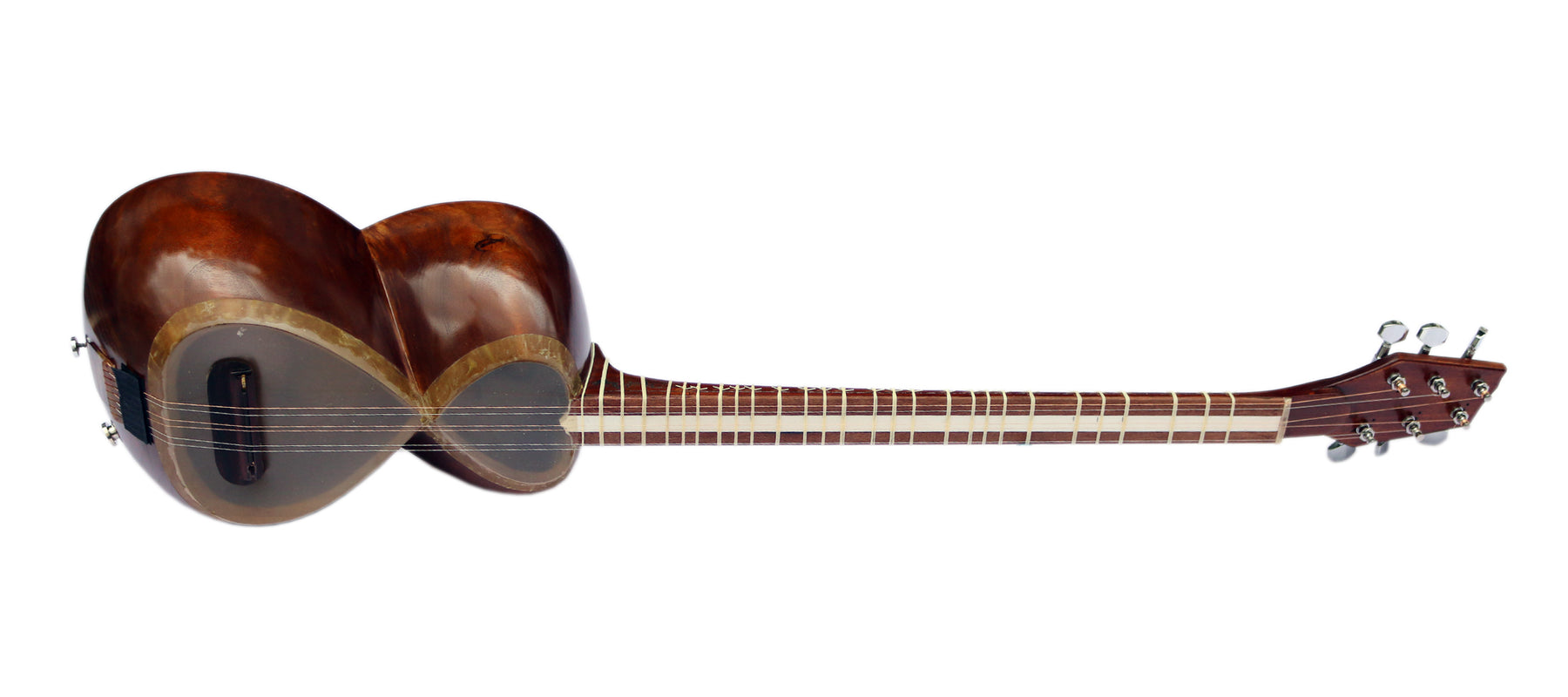
The tar’s most recognizable feature is its double-chambered, figure-eight body carved from mulberry wood and covered with a thin membrane, traditionally lambskin. This membrane acts as a resonating surface, giving the instrument its bright yet nuanced tone, somewhere between the depth of a wooden lute and the immediacy of a skin-headed instrument.
The Persian tar typically carries six metal strings arranged in three double courses and is played seated, with the instrument resting against the chest. Its movable frets (usually tied with gut or nylon) allow performers to adjust microtonal intervals according to the requirements of each dastgah. The instrument is plucked with a small brass plectrum (mezrab), producing a sharp, articulate attack balanced by sustained resonance.
The Azerbaijani tar is structurally larger and incorporates additional sympathetic strings. These extra strings enrich the resonance and increase brilliance, supporting the dramatic, expansive character of mugham performance. The instrument is often held differently, and its projection is designed for ensemble contexts that may include voice, kamancheh, and percussion.
These are not superficial differences. They reflect divergent aesthetic priorities within two sophisticated modal traditions.
Modernization and Standardization
In the 20th century, both Persian and Azerbaijani musical institutions underwent processes of modernization. Conservatories formalized teaching methods, repertoire was transcribed, and instrument construction became more standardized. In Azerbaijan particularly, structural modifications increased volume and adaptability for orchestral performance.
Yet despite these transformations, the tar remains deeply tied to oral pedagogy. Master musicians continue to transmit repertoire and interpretive nuance through close teacher-student relationships, ensuring that technical standardization does not erase expressive individuality.
The tar today moves between traditional gatherings, conservatory classrooms, international festivals, and recording studios, illustrating how an instrument can evolve across political borders while maintaining continuity within modal systems.
Choosing the Best Tar: A Beginner’s Guide
Selecting a tar requires first deciding which musical tradition you intend to study. A Persian tar designed for radif performance differs structurally and acoustically from an Azerbaijani tar built for mugham.
Other factors to consider include:
- Material and Craftsmanship: The quality of the wood carving, membrane tension, fret placement, and overall balance directly affect intonation and responsiveness. Because both traditions rely on microtonal accuracy, even small construction flaws can limit expressive precision.
- Fretwork: Movable frets tied with gut or nylon allow for precise tuning adjustments.
- Accessories: A quality Tar should come with a protective case, extra strings, and a mezrab.
- Budget: Prices vary based on craftsmanship and materials. Rather than focusing primarily on decorative details or price, it is more meaningful to seek an instrument crafted by a specialist familiar with the modal system it is meant to serve.
The tar reveals its character gradually; it rewards attentive listening more than immediate volume.
The curated selection below aims to support informed decision-making while encouraging awareness of the instrument’s cultural origins.
Top 7 Tar To Buy
Best Tar for Beginners
1) Tar By Afshari

Instrument Profile
| Maker | Afshari |
| Origin | Iran (Persian tradition) |
| Body Material | Mulberry wood |
| Neck Material | Mulberry wood |
| Fingerboard | Bone |
| Tuning Pegs | Walnut |
| Strings | Metal strings |
| Included Accessories | Hard case, mezrab (pick), extra strings |
Acoustic Characteristics
The Tar by Afshari produces a bright, articulate, and highly expressive sound, characteristic of the Persian tar tradition. The mulberry wood body and neck contribute to a warm yet responsive tonal foundation, while the bone fingerboard enhances clarity, precision, and attack definition.
The instrument’s double-bowl resonating body allows for a balanced projection across bass and treble registers, supporting both delicate melodic phrasing and rhythmic articulation. The use of a mezrab (plectrum) enables a crisp, percussive attack, essential for executing the intricate ornamentation and rapid passages typical of Persian classical music.
Overall, the sound is clear, nuanced, and dynamically responsive, well-suited to the expressive demands of the radif repertoire.
Strengths ✅
- High-quality traditional materials (mulberry wood, bone, walnut)
- Clear, articulate tone with strong projection
- Suitable for detailed ornamentation and expressive playing
- Includes essential accessories (hard case, mezrab, extra strings)
- Handcrafted instrument aligned with Persian musical tradition
Considerations ⚠️
- Requires specific technique and familiarity with Persian music systems
- Tuning and maintenance may be complex for beginners
- Bone fingerboard requires careful handling
2) High Quality Carved Mulberry Tar By Delnavaz

Instrument Profile
| Maker | Delnavaz |
| Origin | Iran (Persian tradition) |
| Body Material | Carved mulberry wood |
| Soundboard | Lamb skin |
| Neck Material | Walnut |
| Fingerboard | Bone |
| Nut | Bone |
| Strings | Metal strings |
| Included Accessories | Hard case, mezrab (pick), extra strings |
Acoustic Characteristics
The Delnavaz Carved Mulberry Tar offers a rich, resonant, and highly nuanced tonal character, shaped by its traditional combination of carved mulberry wood and a lamb skin soundboard. This construction produces a warm, organic resonance with a slightly textured attack, characteristic of high-quality Persian tar instruments.
The lamb skin membrane plays a crucial role in shaping the sound, contributing to a responsive, slightly percussive timbre with a natural compression that enhances articulation. The bone fingerboard and nut further refine the sound, providing clarity, brightness, and precision, especially in fast melodic passages and ornamentation.
Compared to fully wooden instruments, this design allows for a more dynamic and expressive response, making it particularly suitable for the subtle microtonal phrasing and intricate techniques of Persian classical music.
Strengths ✅
- High-quality traditional construction with carved mulberry body and lamb skin top
- Rich, expressive tone with strong dynamic response
- Bone fingerboard and nut enhance clarity and articulation
- Suitable for advanced ornamentation and Persian classical repertoire
- Includes essential accessories (hard case, mezrab, extra strings)
- Handcrafted instrument aligned with traditional craftsmanship
Considerations ⚠️
- Skin soundboard is sensitive to humidity and temperature changes
- Requires careful maintenance and handling
- Tuning and technique may be challenging for beginners
- Specialized instrument primarily suited to Persian musical contexts
3) High Quality Azeri Tar

Instrument Profile
| Origin | Azerbaijan / Caucasus region |
| Body Material | Carved mulberry wood |
| Soundboard | Lamb skin |
| Neck Material | Walnut |
| Tuning Pegs | Walnut |
| Nut | Bone |
| Strings | Metal strings |
| Included Accessories | Hard case, extra strings |
Acoustic Characteristics
The High Quality Azeri Tar produces a bright, powerful, and highly projecting sound, distinct from the Persian tar due to its different construction and playing technique. The carved mulberry body combined with a lamb skin soundboard creates a clear, focused tone with strong attack and immediate response.
Compared to the Persian tar, the Azeri version is typically played closer to the chest and emphasizes a more virtuosic, rhythmically driven style, resulting in a sound that is more direct, brilliant, and cutting. The skin membrane enhances articulation and percussive clarity, while the walnut neck and bone nut contribute to stability and tonal precision.
The overall sound is lively, expressive, and highly dynamic, well-suited for fast passages, ornamentation, and ensemble performance within Azerbaijani mugham traditions.
Strengths ✅
- Bright, powerful tone with strong projection
- Traditional carved mulberry and skin construction
- Highly responsive and suitable for virtuosic playing
- Clear articulation ideal for fast melodic passages
- Includes hard case and extra strings
- Well-suited for ensemble and traditional mugham performance
Considerations ⚠️
- Different technique compared to Persian tar (may require adaptation)
- Skin soundboard is sensitive to humidity and temperature
- Requires specific stylistic knowledge (mugham tradition)
- Less versatile outside its traditional musical context
4) Left Handed Tar By Delnavaz

Instrument Profile
| Maker | Delnavaz |
| Origin | Iran (Persian tradition) |
| Body Material | Carved mulberry wood |
| Soundboard | Lamb skin |
| Neck Material | Walnut |
| Fingerboard | Bone |
| Nut | Bone |
| Strings | Metal strings |
| Orientation | Left-handed |
| Included Accessories | Hard case, mezrab (pick), extra strings |
Acoustic Characteristics
The Left-Handed Tar by Delnavaz offers the same rich, warm, and highly expressive tonal qualities as its right-handed counterpart, adapted for left-handed players. The combination of carved mulberry wood and lamb skin soundboard produces a balanced resonance with a slightly percussive attack, characteristic of traditional Persian tar construction.
The lamb skin membrane enhances dynamic responsiveness and tonal texture, while the bone fingerboard and nut contribute to clarity and articulation, especially in intricate melodic passages and ornamentation. The instrument supports the nuanced microtonal phrasing and expressive techniques central to Persian classical music.
Its left-handed configuration ensures natural ergonomics and control for left-handed musicians, without compromising acoustic performance.
Strengths ✅
- Left-handed design for improved comfort and playability
- High-quality traditional materials (mulberry, walnut, bone, lamb skin)
- Rich, expressive sound with strong dynamic response
- Suitable for detailed ornamentation and Persian classical repertoire
- Includes essential accessories (hard case, mezrab, extra strings)
- Handcrafted instrument aligned with traditional craftsmanship
Considerations ⚠️
- Limited availability compared to standard right-handed models
- Skin soundboard is sensitive to humidity and temperature
- Requires specific technique and familiarity with Persian music
- Specialized instrument less suited for general-purpose use
Best Professional Tar
5) Professional Electric Tar
Instrument Profile
| Origin | Iran (Persian tradition) |
| Body Material | Mulberry wood |
| Soundboard | Lamb skin |
| Neck Material | Walnut |
| Fingerboard | Bone |
| Nut | Bone |
| Electronics | Built-in pickup and equalizer |
| Modes | Acoustic and amplified |
| Strings | Metal strings |
| Orientation | Left-handed |
| Included Accessories | Hard case, mezrab (pick), extra strings |
Acoustic Characteristics
The Professional Electric Tar combines the traditional tonal richness of the Persian tar with the flexibility of modern amplification. Acoustically, it retains the instrument’s characteristic warm, resonant sound with a slightly percussive attack, shaped by the lamb skin soundboard and mulberry body.
When amplified, the built-in pickup system captures the instrument’s nuances with clarity and precision, while the integrated equalizer allows players to shape the tone in real time, adjusting bass, midrange, and treble frequencies according to performance needs.
This dual nature enables a wide range of applications: from intimate acoustic settings to live amplified performances, where projection and tonal control are essential. The result is a sound that remains expressive and detailed while gaining greater versatility and presence in modern musical contexts.
Strengths ✅
- Hybrid acoustic-electric design for maximum versatility
- Built-in equalizer allows precise tone shaping
- Maintains traditional tar sound with modern projection capabilities
- Suitable for live performance, recording, and fusion contexts
- High-quality traditional materials (mulberry, walnut, bone, lamb skin)
- Includes essential accessories (hard case, mezrab, extra strings)
Considerations ⚠️
- Requires amplification setup to fully utilize electric features
- Skin soundboard remains sensitive to humidity and temperature
- Electronics add complexity compared to fully acoustic models
- May differ in feel and response from purely traditional tar
- Less aligned with strictly traditional performance contexts
6) Professional Flat Tar

Instrument Profile
| Origin | Iran (Persian tradition) |
| Body Material | Mulberry wood (flat body construction) |
| Soundboard | Lamb skin |
| Neck Material | Walnut |
| Fingerboard | Bone |
| Nut | Bone |
| Ergonomics | Strap-compatible design |
| Strings | Metal strings |
| Included Accessories | Hard case, mezrab (pick), extra strings |
Acoustic Characteristics
The Professional Flat Tar offers a clear, focused, and responsive sound, combining traditional tonal elements with a modern structural design. The use of mulberry wood and a lamb skin soundboard preserves the characteristic warm resonance and slightly percussive attack typical of the Persian tar.
However, the flat body construction results in a more direct and controlled projection, with slightly less natural resonance compared to the traditional double-bowl design. This makes the sound more precise and immediate, particularly suitable for amplified contexts or ensemble settings where clarity is essential.
The overall tonal character remains expressive and articulate, while the modern design enhances consistency and playability.
Strengths ✅
- Ergonomic flat body design for improved comfort and playability
- Strap compatibility allows standing performance
- Mechanical tuners provide precise and stable tuning
- Clear, focused sound with strong articulation
- Suitable for live performance and modern playing contexts
- Includes essential accessories (hard case, mezrab, extra strings)
Considerations ⚠️
- Reduced acoustic resonance compared to traditional double-bowl tar
- Modern design departs from traditional construction aesthetics
- Skin soundboard remains sensitive to humidity and temperature
- May feel different for players accustomed to traditional tar ergonomics
- Less aligned with strictly traditional performance contexts
7) Professional Tar By Ali Yasin

Instrument Profile
| Maker | Ali Yasin |
| Origin | Iran (Persian tradition) |
| Body Material | Mulberry wood |
| Soundboard | Lamb skin |
| Neck Material | Walnut |
| Strings | Metal strings |
| Included Accessories | Hard case, mezrab (pick), extra strings |
Acoustic Characteristics
The Professional Tar by Ali Yasin delivers a rich, balanced, and highly expressive tone, reflecting the craftsmanship associated with experienced luthiers in the Persian tradition. The mulberry body provides a warm and resonant foundation, while the lamb skin soundboard adds a slightly textured, percussive attack that enhances articulation.
The instrument responds with clarity and dynamic sensitivity, allowing for subtle variations in touch and phrasing. Its tonal profile supports both delicate melodic passages and more rhythmically defined playing, making it suitable for the nuanced microtonal language of Persian classical music.
Overall, the sound is refined and responsive, with a natural balance between depth and brightness.
Strengths ✅
- Crafted by an experienced and recognized tar maker
- Warm, balanced tone with expressive dynamic range
- Traditional materials (mulberry wood and lamb skin) ensure authentic sound
- Responsive to nuanced articulation and ornamentation
- Suitable for Persian classical repertoire and advanced playing
- Includes essential accessories (hard case, mezrab, extra strings)
Considerations ⚠️
- Skin soundboard is sensitive to humidity and temperature
- Requires specific technique and familiarity with Persian music
- Limited versatility outside traditional or modal contexts
- Higher-level instrument may be less accessible for beginners
Final Considerations
The tar is not a generic Middle Eastern lute. It is a modal instrument shaped by specific historical trajectories in Iran and the Caucasus, refined within oral theoretical systems, and adapted through modern institutional reforms.
Its journey across regions demonstrates how musical culture travels, transforms, and redefines itself without dissolving into uniformity.
“This article is written from an educational perspective for a global audience. It does not replace the knowledge transmitted within original communities, and readers are encouraged to seek information directly from original sources whenever possible.”
Tag:Strings
